
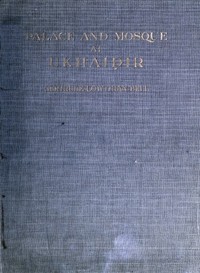
Palace and Mosque at Ukhaidir: A Study in Early Mohammadan Architecture by Bell
Let's be clear: this book is not a novel. But it has all the elements of a great story. It's Gertrude Bell's first-hand account of her expeditions to a remote desert site called Ukhaidir in what is now Iraq. Her mission? To document, measure, and understand a massive, mysterious complex that everyone else had ignored or looted for stones.
The Story
The 'plot' follows Bell's journeys. She arrives at this imposing ruin—part palace, part mosque—sticking out of the empty landscape. No one knows who built it or when. Using her training and a keen eye, she becomes an architectural detective. She takes photographs (risky with early equipment in the desert), makes detailed drawings, and compares every arch and vault to other known sites. She argues with local guides, deals with suspicious Ottoman officials, and battles the harsh environment. The central mystery she's trying to crack is the building's origin and its place in the story of early Islamic design. Is it a bridge between ancient Persian and later Muslim architecture? Her book is the report of her findings, but it reads like her field notes from a thrilling investigation.
Why You Should Read It
You read this for Bell's voice. She's fiercely intelligent, witty, and sometimes frustratingly sure of herself. You get her passion for the desert and her genuine awe for the builders of Ukhaidir. The book pulls you into her world. One minute she's calmly explaining the geometry of a dome, the next she's complaining about the wind ruining her photographic plates. It makes a very technical subject feel human and urgent. You're not just learning about arches; you're learning why this specific arch, in this forgotten place, mattered so much to her. It’s a window into a time when discovery meant riding for days into the unknown, not clicking a search button.
Final Verdict
Perfect for armchair travelers, history detectives, and anyone who loves stories about passionate, unconventional people. If you enjoy the idea of history as a physical puzzle you can touch, you'll love this. It's also a must-read if you're interested in the roots of Middle Eastern archaeology or in remarkable women who defied every expectation of their era. Just be ready for some detailed architectural descriptions—but even those are filled with the personality of the woman who wrote them.
This book is widely considered to be in the public domain. Knowledge should be free and accessible.
Thomas Martin
1 year agoI started reading this with a critical mind, the objective evaluation of the pros and cons is very refreshing. It’s hard to find this much value in a single source these days.
Donald Rodriguez
2 years agoThis was exactly the kind of deep dive I was searching for, the bibliography and references suggest a high level of research and authority. A mandatory read for anyone in this industry.
Robert Moore
9 months agoIt took me a while to process the complex ideas here, but the bibliography and references suggest a high level of research and authority. I'm glad I chose this over the other alternatives.
Barbara Wilson
1 month agoAs a professional in this niche, the case studies and practical examples provided add immense value. I appreciate the effort that went into this curation.




Charles Davis
8 months agoUnlike many other resources I've purchased before, the step-by-step breakdown of the methodology is extremely helpful for students. I feel much more confident in my knowledge after finishing this.