
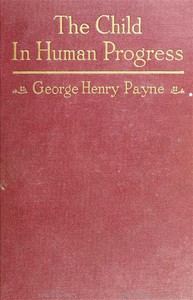
The Child in Human Progress by George Henry Payne
Published in 1916, George Henry Payne's The Child in Human Progress isn't a novel with a plot, but it presents an argument with the momentum of a detective story. Payne, a journalist, acts like a historical investigator, sifting through evidence from ancient laws, medieval manuscripts, Renaissance art, and early industrial records. His goal is to trace the shifting status of children across Western civilization.
The Story
Payne's journey starts in the ancient world, where he finds that concepts like 'childhood innocence' or dedicated play were largely absent. He shows how children were often seen as economic assets or political pawns. The book moves through the Middle Ages and into the Renaissance, pointing out how children in art were frequently just shrunken-down versions of their parents. The real turning point, he argues, begins with philosophical shifts in the 17th and 18th centuries—think thinkers like John Locke and Jean-Jacques Rousseau—who started to promote ideas about education and natural development. Payne then connects these ideas to the social reforms of the 19th century that finally began tackling child labor and advocating for universal education.
Why You Should Read It
This book stuck with me because it challenges a fundamental belief: that loving and protecting kids is just human nature. Payne convincingly shows it's more of a hard-won cultural achievement. Reading it, you'll never look at a history book the same way. You start noticing the kids in the background of historical events and wondering about their lives. It's not a dry academic text; it's written with a reporter's clarity and a clear sense of moral purpose. While some of his 1916 perspectives feel dated, the core revelation—that our current view of childhood was constructed, not inevitable—is incredibly powerful.
Final Verdict
Perfect for curious readers who love history, sociology, or parenting topics, but from a completely unexpected angle. It's for anyone who's ever wondered 'why do we do it that way?' about raising kids. Be prepared for some grim historical facts, but also for a genuine sense of awe at the progress we often take for granted. This is a fascinating, perspective-altering read that proves sometimes the most revolutionary stories are the ones hiding in plain sight, in the lives of the smallest people.
This is a copyright-free edition. Knowledge should be free and accessible.
Karen Garcia
4 months agoA sophisticated analysis that fills a gap in the literature.
Donna Clark
1 year agoNot bad at all.
Sandra Martinez
1 year agoTo be perfectly clear, the clarity of the writing makes this accessible. Definitely a 5-star read.
Nancy Hernandez
2 years agoThe layout is very easy on the eyes.




Margaret Martin
5 months agoThis was exactly the kind of deep dive I was searching for, the step-by-step breakdown of the methodology is extremely helpful for students. A mandatory read for anyone in this industry.