
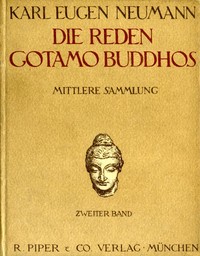
Die Reden Gotamo Buddhos. Mittlere Sammlung, zweiter Band by Karl Eugen Neumann
This book isn't a novel. Think of it as a carefully curated transcript. Die Reden Gotamo Buddhos is Karl Eugen Neumann's early 20th-century German translation of the Majjhima Nikaya, one of the core collections of the Buddha's teachings. This second volume contains dozens of individual discourses, or suttas. They are framed as dialogues. Often, someone—a monk, a king, a farmer—comes to the Buddha with a question: What is the self? How do I find peace? Why do we suffer?
The Story
There's no single narrative. Instead, you follow the Buddha and his community across ancient India. Each chapter is a standalone scene. He might be debating a brahmin priest about ritual, gently guiding a grieving mother, or giving detailed meditation instructions to his monks. The 'plot' is the unfolding of understanding. A person arrives confused or troubled; through logical reasoning, parables, and direct experience, the Buddha points them toward seeing things as they really are. The central thread is the explanation of the Four Noble Truths and the Noble Eightfold Path, the practical roadmap at the heart of his teaching.
Why You Should Read It
Reading Neumann's translation feels raw and immediate. This isn't a modern interpretation. It's the philosophical bedrock. What struck me was the Buddha's relentless practicality. He's less interested in cosmic mysteries than in the stress you're feeling right now. His insights into how the mind creates its own misery are shockingly current. The language is repetitive—that's part of the oral tradition—but that repetition drills the ideas deep. You're not just reading about mindfulness; you're seeing it built, concept by concept, from the ground up. It strips away centuries of cultural baggage and gets to the core.
Final Verdict
This is not for the casual beach reader. It's for the intellectually curious explorer. Perfect for philosophy students, serious meditation practitioners, or anyone who wants to engage with foundational religious texts directly. If you've enjoyed authors like Stephen Batchelor or Thich Nhat Hanh, this is the classic source they're drawing from. Be warned: it's dense. Read it slowly, a discourse at a time. Think of it as a manual for the mind, written with startling precision. It's a challenging, often dry, but profoundly rewarding deep dive.
This work has been identified as being free of known copyright restrictions. Thank you for supporting open literature.
Barbara Lopez
3 months agoGreat value and very well written.
Betty Lewis
8 months agoHaving read this twice, it creates a vivid world that you simply do not want to leave. Worth every second.
Jennifer Rodriguez
1 year agoI came across this while browsing and it provides a comprehensive overview perfect for everyone. One of the best books I've read this year.
Thomas Johnson
2 years agoGreat reference material for my coursework.


Richard Brown
2 years agoThe clarity of the introduction set high expectations, and the nuanced approach to the central theme was better than I expected. A perfect balance of theory and practical advice.