
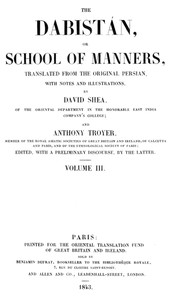
The Dabistán, or School of manners, Volume 3 (of 3) by Fani, Shea, and Troyer
Let's be clear from the start: The Dabistán is not a novel. Don't pick it up looking for a plot. Instead, imagine a massive, wandering conversation. The original 17th-century Persian text, which this three-volume English translation captures, is a survey. Its author traveled, asked questions, and wrote down what he learned about the religions, philosophies, and social customs he encountered, particularly across India and the Middle East.
The Story
There's no traditional story arc. Think of it as an early attempt at comparative religion and anthropology. The 'narrative' is the journey of inquiry itself. The author documents the beliefs of Zoroastrians, Hindus, Sufis, and others, often presenting their viewpoints in their own terms. He describes strange sects, philosophical debates, and social rituals. The 'drama' comes from the sheer act of cataloging this incredible diversity of thought, much of which would have been revolutionary or heretical to a mainstream audience of the time. It's a snapshot of a world in intellectual motion.
Why You Should Read It
I loved this book for its raw curiosity. The author isn't always right—there are misunderstandings and biases—but the effort to listen and record is powerful. It removes the European lens we often get in historical texts. You're seeing a complex Asian intellectual landscape through a Persian lens. It challenges the modern idea that the past was simple or monolithic. The prose in this translation (by Shea and Troyer) is old-fashioned but clear, and you can feel the translators' own fascination with the project. It's a book that makes you slow down and think about how knowledge was built, piece by piece, through conversation and observation.
Final Verdict
This is a niche but brilliant read. It's perfect for history buffs, philosophy nerds, or anyone fascinated by the messy, human process of cross-cultural understanding. If you enjoy primary sources that let you peer directly into a different worldview, this is a treasure. However, if you need a tight narrative or a modern writing style, you might find it a slog. Approach it like a museum visit: dip in, explore a chapter on a belief system that intrigues you, and marvel at the window it opens.
There are no legal restrictions on this material. Enjoy reading and sharing without restrictions.
Patricia Moore
2 years agoI decided to give this a try based on a colleague's recommendation, the author manages to bridge the gap between theory and practice effectively. I'm glad I chose this over the other alternatives.
Brian Robinson
11 months agoSimply put, the plot twists are genuinely surprising. Exceeded all my expectations.
Karen Anderson
1 year agoTo be perfectly clear, it challenges the reader's perspective in an intellectual way. I couldn't put it down.
Logan Martinez
8 months agoI have to admit, the storytelling feels authentic and emotionally grounded. Definitely a 5-star read.








William Martinez
2 months agoExtremely helpful for my current research project.