About 1,919 minutes
The Gutenberg Webster's Unabridged Dictionary: Section D and E — A Closer Reading
Dictionaries Reference
441,265 recorded words. 51 minutes difference from this book's estimate.
View Gutenberg source #662
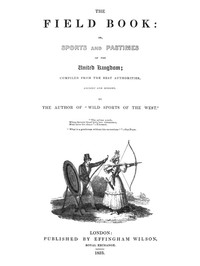
The source record for The Field Book: or, Sports and pastimes of the United Kingdom compiled from the best authorities, ancient and modern — Background and Themes measures this digital text at 452,918 words, 32 hr 50 min estimated reading time, and 63 detected text sections.
The text analysis averages about 23.0 words per sentence, while the detected sections provide another way to judge how the source is divided.
Project Gutenberg metadata also associates the work with “Sports -- Great Britain,” connecting these edition facts with the source record’s subject description.
Explore this collection
These alternatives are selected using recorded categories and estimated reading time.
About 1,919 minutes
Dictionaries Reference
441,265 recorded words. 51 minutes difference from this book's estimate.
View Gutenberg source #662About 1,871 minutes
Dictionaries Reference
430,183 recorded words. 99 minutes difference from this book's estimate.
View Gutenberg source #661About 1,501 minutes
Dictionaries Reference
345,182 recorded words. 469 minutes difference from this book's estimate.
View Gutenberg source #26000Search stored excerpts and compare books → Choose by your preferences →
Choices use stored catalog measurements. Estimates vary with reading speed. A shared category is a catalog label, not a claim that two books have the same argument or literary quality.
Search reads excerpt text stored with this catalog and links to its associated Gutenberg record. The connection is stored in the site database; this tool does not recheck that every excerpt is word-for-word identical to that external record. Excerpt search does not cover every chapter and does not verify historical publication dates.
Catalog snapshot checked: 2026-09-26. Coverage: 93 public books, 93 available source excerpts.
Calculated from edition completeness, EPUB availability, text structure and catalogue metadata. Not a user rating.
Total of 100 points, scaled to a 2.5-5.0 range. Editions with an empty description or a missing EPUB file are not scored.
Public-domain source text
The source text is kept in the dedicated reader, separate from this catalogue record and its commentary.
W. H. Maxwell’s The Field Book (1833) presents itself as a comprehensive reference for British sports and pastimes, yet its structure resists simple categorization. The volume moves between extended essays—such as the introduction’s critique of outdated sporting literature—and concise dictionary entries on topics from “Lampass” to “Landrail.” This hybrid form reflects the compiler’s stated aim: to replace “barbarous theories” and “hackneyed matter” with a work suited to a transformed sporting world. The excerpts reveal a text that is as much about the history of sporting knowledge as it is about practical instruction.
Maxwell opens with a pointed assessment of earlier sporting books. He dismisses older authors for offering little more than “quaint and curious anecdote” and “barbarous theories,” while more recent works are “merely reprints of treatises for years before the public.” His own volume, he implies, will correct this stagnation. The introduction’s tone is confident, even combative, as it catalogs obsolete practices: jockeys in tie-wigs, fishermen in velvet caps, and remedies involving “a dead-man’s finger” or a roasted sucking-mastiff. These examples serve not only to amuse but to mark a clear break between past and present. Maxwell positions himself as a modernizer, aligning with “practical and scientific improvement.” Yet the book’s contents—mixing veterinary advice, natural history, and antiquarian notes—suggest that the break is less absolute than he claims. The dictionary entries, for instance, retain a fondness for curious detail that echoes the very works he criticizes.
The dictionary entries in The Field Book vary widely in length and style. Some, like “Lampass,” offer straightforward veterinary instruction: a description of the condition, a recommended treatment (lancing with a penknife), and a citation to an authority named “White.” Others, like “Lamprey,” expand into a digressive anecdote about a Roman fishpond and a dubious inscription claiming that lampreys were fed on human blood. The entry then questions the evidence, noting the “neat and impenetrable covering of stucco” and the lack of proof. This shift from practical to speculative mirrors the book’s broader tension between utility and entertainment. The entry on “Landrail” provides a brief physical description—length, bill color, eye color—but stops short of hunting advice, leaving the reader with a naturalist’s note rather than a sportsman’s tip. Such entries suggest that Maxwell’s audience was expected to value curiosity as much as instruction.
Throughout the excerpts, a pattern emerges: the text repeatedly contrasts old and new, but also shows how older practices persist. The introduction’s catalog of obsolete customs—tie-wigs, velvet caps, superstitious baits—is vivid, yet the dictionary entries themselves preserve fragments of that older world. The lamprey anecdote, for example, is drawn from “Letters from the Campagna Felice,” a source that Maxwell does not dismiss. Similarly, the entry on “Lameness in Dogs” offers a preventive remedy (washing feet with brine) that is practical and modern, but the recommended ingredients—pot-liquor or salt and vinegar—are homely and traditional. This juxtaposition suggests that the “total revolution” Maxwell proclaims is not a clean break but a reordering of knowledge. The book’s structure, moving between essay and dictionary, enacts this reordering, allowing old and new to sit side by side.
The Field Book shifts abruptly between modes: from the personal, almost polemical introduction to the alphabetical list of entries; from a single sentence on “Lampblack” (a recipe for making the pigment) to a multi-paragraph story about Roman fishponds. This movement is not random but reflects the compiler’s method of gathering “the best authorities, ancient and modern.” The entries vary in scale as well: some are brief definitions, others are miniature articles. The effect is a text that resists linear reading. A reader might open the book for a specific term—say, “Landmark”—and find a one-line definition, then turn a page and encounter a detailed account of the landrail’s plumage. This variety suggests that the book was designed for browsing rather than sustained reading, a quality that aligns with its stated purpose as a “field book” for practical reference. Yet the inclusion of extended narratives, like the lamprey story, also invites leisurely perusal.
Readers approaching The Field Book should expect a work that defies easy classification. It is neither a systematic treatise nor a mere glossary, but a compilation that reflects the eclectic interests of its compiler. The most rewarding approach may be to treat it as a cabinet of curiosities: dip in at any point, follow the cross-references, and allow the juxtapositions to reveal the shifting landscape of early nineteenth-century sporting culture. The book’s value lies not in a single argument but in the accumulation of voices and details it preserves.
There’s something comforting about an old compendium, isn’t there? That 1833 field book felt like sitting with a friend who knew every hedge and stream, trading superstition for science without losing the wonder. It lingered. I found that same gentle thoroughness in The Sailor's Word-Book An Alphabetical Digest of Nautical Terms, including Some More Especially Military and Scientific, but Useful to Seamen; as well as Archaisms of — A Reader’s Guide, a quiet archive of a whole vanished world.
Answer a few questions and save a private reflection on this device.
![Cover of The 1990 United States Census [2nd] — A Closer Reading](https://frouu.com/storage/media/covers/pg37.jpg)