About 354 minutes
Language: An Introduction to the Study of Speech — Key Ideas to Explore
Language Study
81,222 recorded words. 13 minutes difference from this book's estimate.
View Gutenberg source #12629
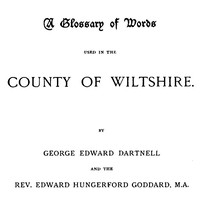
The catalog record for A Glossary of Words used in the Country of Wiltshire — A Reader’s Guide provides practical reading context through 78,272 words, 5 hr 41 min estimated reading time, and 12 detected text sections.
The text analysis averages about 11.2 words per sentence, while the detected sections provide another way to judge how the source is divided.
Project Gutenberg metadata also associates the work with “English language -- Glossaries, vocabularies, etc.,” connecting these edition facts with the source record’s subject description.
Explore this collection
These alternatives are selected using recorded categories and estimated reading time.
About 354 minutes
Language Study
81,222 recorded words. 13 minutes difference from this book's estimate.
View Gutenberg source #12629About 326 minutes
Language Study
74,853 recorded words. 15 minutes difference from this book's estimate.
View Gutenberg source #33197About 381 minutes
Language Study
87,441 recorded words. 40 minutes difference from this book's estimate.
View Gutenberg source #73237Search stored excerpts and compare books → Choose by your preferences →
Choices use stored catalog measurements. Estimates vary with reading speed. A shared category is a catalog label, not a claim that two books have the same argument or literary quality.
Search reads excerpt text stored with this catalog and links to its associated Gutenberg record. The connection is stored in the site database; this tool does not recheck that every excerpt is word-for-word identical to that external record. Excerpt search does not cover every chapter and does not verify historical publication dates.
Catalog snapshot checked: 2026-09-26. Coverage: 93 public books, 93 available source excerpts.
Calculated from edition completeness, EPUB availability, text structure and catalogue metadata. Not a user rating.
Total of 100 points, scaled to a 2.5-5.0 range. Editions with an empty description or a missing EPUB file are not scored.
Public-domain source text
The source text is kept in the dedicated reader, separate from this catalogue record and its commentary.
The glossary entries shift between the concrete and the expressive: a pick is both a hay-making fork and the fruit of the sloe, while peart can mean impertinent, healthy, clever, stinging, or lively. This range reflects the compilers' method of gathering words from across the county, noting where each term is used (N.W., S.W., N. & S.W.) and often citing a source—a newspaper, a novel like Dark, or a previous collector such as Jefferies. The preface acknowledges that the work is not exhaustive, but the five years of collecting produced a list that the authors claim is the most complete yet assembled for Wiltshire.
The glossary covers tools (peck for pickaxe, pick for fork), plants (pig-nut, pickpocket for shepherd's purse), and everyday objects (peel for a lace-making pillow or oven peel). But it also includes abstract terms: pelt for rage, peter grievous for a dismal person. The compilers often give multiple senses for a single word, as with peart (five meanings) or picked (sharp-pointed or looking ill). This layering suggests that dialect words carried nuanced, context-dependent meanings in daily use.
Many entries are supported by quotations from local speech or published works. For pelt, the glossary cites Herrick's Oberon's Palace and a line from the novel Dark: “You zims 'mazin afeert to zee your gran'fer in a pelt!” The entry for peter grievous similarly draws on Dark and notes a variant, pity grievous, at Clyffe Pypard. These citations anchor the words in both literary tradition and living conversation, showing how the compilers wove together written and oral evidence.
Each entry is tagged with a region code—N.W., S.W., N. & S.W.—revealing that Wiltshire dialect was not uniform. For instance, peck (stumble) is marked N.W., while peart (lively) is N.W. but other senses are S.W. or N. & S.W. The compilers also note when a word appears in other counties: pigeon-pair is compared to a North English phrase “a dow's cleckin.” These annotations turn the glossary into a map of linguistic distribution, hinting at how words travelled or stayed local.
The preface mentions that the volume includes “a few short stories, illustrating the dialect as actually spoken,” plus an introduction on pronunciation and appendices on various matters. This framing suggests the glossary is not a bare list but a cultural record. The compilers aimed to preserve not just words but the contexts in which they were used—hence the inclusion of folk-talk examples and the effort to trace etymologies and literary allusions. The work was originally serialized in the Wilts Archæological Magazine before being revised and expanded for book publication.
Readers approaching this glossary will find it rewards browsing as much as lookup. The entries are dense with cross-references and regional notes, and the quotations bring the words to life. Because the compilers drew on both published sources and fieldwork, the volume offers a layered view of late-nineteenth-century Wiltshire speech—its tools, its emotions, its plants, and its people.
That rainy afternoon, I kept returning to how Wiltshire farmworkers named a storm-bent elm a "shrump," as if the landscape itself possessed a vocabulary for weariness. It made me think of all the quiet, uncollected languages we lose — time passing, grass flattening. Later, almost by accident, the old Spalding's Official Baseball Guide - 1913 — Themes and Context landed on the table, and I found the same tenderness there, in how they documented the grunts and shuffles of a game nobody thought needed recording.
Use these questions to collect your thoughts before moving on.