About 394 minutes
A select glossary of English words used formerly in senses different from their present — Key Ideas to Explore
Language Study
90,604 recorded words. 93 minutes difference from this book's estimate.
View Gutenberg source #70210
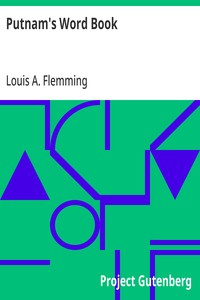
For Putnam's Word Book A Practical Aid in Expressing Ideas Through the Use of an Exact and Varied Vocabulary — A Closer Reading, the stored edition analysis reports 111,904 words, 8 hr 7 min estimated reading time, and 93 detected text sections.
The text analysis averages about 4.6 words per sentence, while the detected sections provide another way to judge how the source is divided.
Project Gutenberg metadata also associates the work with “English language -- Synonyms and antonyms,” connecting these edition facts with the source record’s subject description.
Explore this collection
These alternatives are selected using recorded categories and estimated reading time.
About 394 minutes
Language Study
90,604 recorded words. 93 minutes difference from this book's estimate.
View Gutenberg source #70210About 393 minutes
Language Study
90,286 recorded words. 94 minutes difference from this book's estimate.
View Gutenberg source #34176About 389 minutes
Language Study
89,258 recorded words. 98 minutes difference from this book's estimate.
View Gutenberg source #2468Search stored excerpts and compare books → Choose by your preferences →
Choices use stored catalog measurements. Estimates vary with reading speed. A shared category is a catalog label, not a claim that two books have the same argument or literary quality.
Search reads excerpt text stored with this catalog and links to its associated Gutenberg record. The connection is stored in the site database; this tool does not recheck that every excerpt is word-for-word identical to that external record. Excerpt search does not cover every chapter and does not verify historical publication dates.
Catalog snapshot checked: 2026-09-26. Coverage: 93 public books, 93 available source excerpts.
Calculated from edition completeness, EPUB availability, text structure and catalogue metadata. Not a user rating.
Total of 100 points, scaled to a 2.5-5.0 range. Editions with an empty description or a missing EPUB file are not scored.
Public-domain source text
The source text is kept in the dedicated reader, separate from this catalogue record and its commentary.
Louis A. Flemming's Putnam's Word Book, originally published in 1913 under the title Synonyms, Antonyms, and Associated Words, is a reference work that organizes vocabulary by headword. The preface states that the book's purpose is not to create or influence usage, but to provide words that can be used, leaving readers to determine which best express their thoughts. Flemming notes that synonyms are not interchangeable and advises consulting a dictionary for unfamiliar words.
The catalog subjects list only "English language -- Synonyms and antonyms," but the excerpts reveal a broader scope. Entries include not only synonyms and antonyms but also "associated words"—terms related in meaning or usage. For example, under "life" one finds "biology, biologist, vital, biometry, biogenesis, macrobiotics, vitalization, vitalize, bioplasm, protoplasm, elixir, biotic." This feature, described in the preface as a memory-help, extends the book beyond simple synonym lists into a network of conceptually linked vocabulary.
Each entry in the excerpts follows a consistent pattern: the headword (e.g., "liberal"), its part of speech, a list of synonyms, and often antonyms introduced by "Antonyms:". Some entries also include "Associated words" with technical terms. For instance, "light" (noun) lists synonyms like "illumination; lamp, taper, candle" and associated words such as "photology, photologist, photophobia, catoptrics, dioptrics, photics, Ormuzd, luminary." This mix of common and specialized vocabulary suggests the book aimed at both general readers and specialists. The preface confirms that the author included technical terms for students and workers in special fields. The entry for "light" also covers multiple senses—noun, adjective, and verb—each with its own list, showing attention to polysemy.
Flemming explicitly avoids prescribing usage. The preface states the book does not attempt to "create or to influence usage by pointing out which words should or should not be used." This descriptive stance is evident in entries like "like blazes" labeled "(Low) furiously, rapidly," and "lick" with colloquial senses "flog, thrash, chastise." The inclusion of informal or low-register terms without judgment aligns with the goal of providing words someone "may want to know as a matter of information." The book also includes antonyms only when they are not obvious; for example, no antonyms are given for "good" because "bad" comes to mind. This practical approach prioritizes utility over completeness.
The excerpts reveal a work designed for writers and speakers seeking precision. The preface mentions "those who want to write and speak with precision and effectiveness." Entries like "liberality" with antonyms "illiberality, stinginess, bigotry" and "liberty" with "captivity, bondage, servitude" show attention to nuanced oppositions. The inclusion of technical terms—such as "holophote" and "pharology" under "lighthouse"—suggests an audience with specialized interests. The book's structure, with associated words grouped under general terms, serves as a memory aid for when a specific word cannot be recalled. This feature, combined with the descriptive approach, makes the volume a tool for expanding vocabulary rather than a strict usage guide.
Readers approaching Putnam's Word Book should treat it as a thesaurus-like resource with a distinctive emphasis on associated words. The preface's advice to verify unfamiliar words in a dictionary remains relevant. The book's 1913 publication date means some terms may be dated, but its systematic arrangement and inclusion of technical vocabulary offer a snapshot of early 20th-century lexicography. For those interested in historical vocabulary or seeking a reference that groups words by conceptual links, this work provides a unique perspective.
I found myself thinking about that old 1913 word book again—how gently it let me wander through meanings without pushing any single one. It felt like sitting quietly with a friend who knows language isn't about rules but about finding the right shade. That same unhurried patience lives in Language: An Introduction to the Study of Speech — Key Ideas to Explore, which I keep returning to, like a familiar walk.
Save your reaction, strongest insight, and memorable passage.