About 389 minutes
Repertory of The Comedie Humaine, Part 1 — Edition Insights
Language Study
89,258 recorded words. 8 minutes difference from this book's estimate.
View Gutenberg source #2468
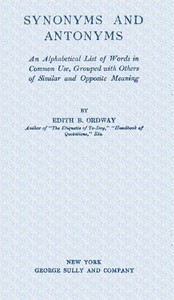
Synonyms and antonyms — Reading Notes can be approached with a clearer sense of reading commitment from its source measurements: 87,441 words, 6 hr 21 min estimated reading time, and 34 detected text sections.
The text analysis averages about 9.7 words per sentence, while the detected sections provide another way to judge how the source is divided.
Project Gutenberg metadata also associates the work with “English language -- Synonyms and antonyms,” connecting these edition facts with the source record’s subject description.
Explore this collection
These alternatives are selected using recorded categories and estimated reading time.
About 389 minutes
Language Study
89,258 recorded words. 8 minutes difference from this book's estimate.
View Gutenberg source #2468About 393 minutes
Language Study
90,286 recorded words. 12 minutes difference from this book's estimate.
View Gutenberg source #34176About 394 minutes
Language Study
90,604 recorded words. 13 minutes difference from this book's estimate.
View Gutenberg source #70210Search stored excerpts and compare books → Choose by your preferences →
Choices use stored catalog measurements. Estimates vary with reading speed. A shared category is a catalog label, not a claim that two books have the same argument or literary quality.
Search reads excerpt text stored with this catalog and links to its associated Gutenberg record. The connection is stored in the site database; this tool does not recheck that every excerpt is word-for-word identical to that external record. Excerpt search does not cover every chapter and does not verify historical publication dates.
Catalog snapshot checked: 2026-09-26. Coverage: 93 public books, 93 available source excerpts.
Calculated from edition completeness, EPUB availability, text structure and catalogue metadata. Not a user rating.
Total of 100 points, scaled to a 2.5-5.0 range. Editions with an empty description or a missing EPUB file are not scored.
Public-domain source text
The source text is kept in the dedicated reader, separate from this catalogue record and its commentary.
Edith B. Ordway's Synonyms and Antonyms (1913) is a compact reference work built on a consistent, transparent system. The preface states that over five thousand leading words are given, with synonyms and antonyms comprising several thousand more. The order is invariable: synonyms appear immediately after the leading word, followed by the abbreviation 'Ant.' and then the antonyms. Within lists, closely synonymous or antonymic words are grouped by semicolons, as seen in the entry for 'Hesitate,' where 'doubt, pause, delay, demur, waver, vacillate' are set off from 'falter, stammer; dubitate, scruple.'
The part of speech is designated by an abbreviation only when necessary to avoid confusion. Ordway also notes that common words formed from a root word with a prefix have been omitted, directing the reader to the root entry instead. This structure makes the volume a practical tool for writers and students seeking precise vocabulary.
The entries follow a strict alphabetical order, but within each, Ordway employs a nuanced grouping strategy. For example, under 'Abandoned,' the first set of synonyms is 'Discarded, rejected and the p.p. of the syn. of “abandon”;' then a semicolon introduces a second cluster: 'depraved, corrupt, profligate, wicked, unprincipled, shameless, sinful, hardened, impenitent, lost, demoralized, vicious, dissolute, reprobate, graceless, obdurate, licentious, incorrigible, irreclaimable, bad.' This separation distinguishes the literal sense (something left behind) from the moral sense (a person of low character). The antonyms are similarly divided: the first set refers to the literal meaning ('visited, frequented, sociable'), while the second addresses the moral dimension ('virtuous, good, deserving, worthy, commendable, excellent, laudable; reclaimable, penitent; conscientious, correct, upright, righteous, self-controlled').
This pattern recurs in many entries, showing that Ordway did not simply compile lists but organized them by shades of meaning. The entry for 'High' is another example: it begins with 'Prominent, superior, distinguished, preëminent; dignified, great, admirable; recondite, abstruse, occult, profound, dark, obscure, transcendental; proud, haughty, arrogant, supercilious, lordly; boastful, ostentatious, bragging, vainglorious; despotic, domineering, overbearing, tyrannical; turbulent, violent, strong, tumultuous, boisterous; extreme; complete, full; dear; shrill, acute, sharp, high-pitched; northerly, southerly; early, primeval; capital, principal; strong-flavored; noble, exalted, steep, tall, towering, uplifted, elevated, eminent, lofty.' The semicolons here separate distinct senses—physical height, moral elevation, intellectual depth, social arrogance, and so on—making the entry a miniature thesaurus of related but distinct concepts.
The excerpts show that Ordway's work covers a wide range of vocabulary, from common words like 'Help' and 'Hide' to more specialized terms such as 'Hibernal' and 'Heterodox.' The entry for 'Hibernal' lists 'Wintry, brumal, arctic, glacial, frigid' as synonyms and 'Summery, balmy, zephyrous, halcyon, tropical' as antonyms, demonstrating the inclusion of poetic and rare words alongside everyday ones. Similarly, 'Heterodox' is defined as 'Unsound, unorthodox, heretical, freethinking,' with antonyms 'Sound, orthodox.'
However, the excerpts also reveal what the book does not provide. There are no example sentences, usage notes, or etymologies. The entries are purely lists of words, with no guidance on connotation or register. For instance, 'Hideous' lists 'Frightful, dreadful, appalling, horrible, ghastly, terrible, horrid, grim, shocking, grisly; unshapely, ugly, monstrous' as synonyms, but does not distinguish between degrees of intensity or contexts. The user must rely on their own knowledge to choose the right word. The preface acknowledges this by suggesting that readers look up a synonym or antonym to multiply references, implying that the book is a starting point for exploration rather than a definitive guide.
Ordway's preface explicitly states that 'actual references may be multiplied by looking up a synonym or antonym, as well as by consulting cognate words, such as the corresponding noun, verb, or adjective.' This design encourages the reader to treat the book as a network rather than a flat list. For example, the entry for 'Abandon' includes synonyms like 'desert, leave, forsake, depart from, quit, give up, relinquish, discontinue, abdicate, renounce, repudiate, forswear, withdraw from, vacate, surrender, retract, recant, retire from, cast off, abjure, cede, cease, resign, forego, yield, waive, part with, let go, lay down, evacuate, drop, deliver up.' A reader who looks up 'relinquish' would find its own entry, potentially with additional synonyms and antonyms, thus expanding their vocabulary.
The excerpts also show that some entries include cross-references to related forms. Under 'Abandoned,' the first synonym is 'Discarded, rejected and the p.p. of the syn. of “abandon”;' this directs the user to the past participle forms of the synonyms listed under 'Abandon.' Similarly, the antonyms for 'Abandoned' include 'The p.p. of the ant. of “abandon”;' again pointing back to the main entry. This interlinking makes the book more than a simple dictionary; it is a tool for systematic vocabulary building, though it requires active engagement from the reader.
Ordway's Synonyms and Antonyms is best used as a reference for expanding word choice, but its value depends on the reader's willingness to follow cross-references and consider the semicolon groupings as indicators of distinct meanings. The absence of usage examples means that context must be supplied by the reader's own experience or by consulting a dictionary. For those interested in the history of lexicography, this 1913 volume offers a clear snapshot of early twentieth-century approaches to synonymy, prioritizing breadth and systematic arrangement over illustrative detail.
In all my years, Synonyms and Antonyms has been my quiet companion—a patient ledger of every word’s neighbor and shadow. There is a kinship between that alphabetical patience and the earthy particularity of the A Glossary of Words used in the Country of Wiltshire — A Reader’s Guide, both shelving language as one might press wildflowers: gently, precisely, without hurry.
Answer a few questions and save a private reflection on this device.