About 853 minutes
Language: Its Nature, Development and Origin — Reading Notes
Language Study
196,151 recorded words. 33 minutes difference from this book's estimate.
View Gutenberg source #53038
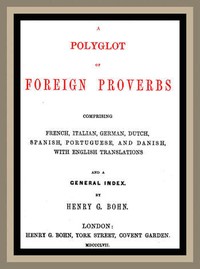
Before opening A Polyglot of Foreign Proverbs Comprising French, German, Dutch, Spanish, Portuguese and Danish, with English Translations and a General Index — Story, Setting & Ideas, the edition data offers a quick orientation: 203,728 words, 14 hr 46 min estimated reading time, and 45 detected text sections.
The text analysis averages about 12.4 words per sentence, while the detected sections provide another way to judge how the source is divided.
Project Gutenberg metadata also associates the work with “Proverbs,” connecting these edition facts with the source record’s subject description.
Explore this collection
These alternatives are selected using recorded categories and estimated reading time.
About 853 minutes
Language Study
196,151 recorded words. 33 minutes difference from this book's estimate.
View Gutenberg source #53038About 929 minutes
Language Study
213,625 recorded words. 43 minutes difference from this book's estimate.
View Gutenberg source #62809About 833 minutes
Language Study
191,408 recorded words. 53 minutes difference from this book's estimate.
View Gutenberg source #28900Search stored excerpts and compare books → Choose by your preferences →
Choices use stored catalog measurements. Estimates vary with reading speed. A shared category is a catalog label, not a claim that two books have the same argument or literary quality.
Search reads excerpt text stored with this catalog and links to its associated Gutenberg record. The connection is stored in the site database; this tool does not recheck that every excerpt is word-for-word identical to that external record. Excerpt search does not cover every chapter and does not verify historical publication dates.
Catalog snapshot checked: 2026-09-26. Coverage: 93 public books, 93 available source excerpts.
Calculated from edition completeness, EPUB availability, text structure and catalogue metadata. Not a user rating.
Total of 100 points, scaled to a 2.5-5.0 range. Editions with an empty description or a missing EPUB file are not scored.
Public-domain source text
The source text is kept in the dedicated reader, separate from this catalogue record and its commentary.
Henry G. Bohn's A Polyglot of Foreign Proverbs (1857) arranges thousands of proverbs from French, Italian, German, Dutch, Spanish, Portuguese, and Danish into language-specific monographs, each sorted alphabetically. The volume's structure—a series of parallel lists—foregrounds the recurrence of similar wisdom across cultures: the Dutch “De kruik gaat zo lang te water dat zij eindelyk breekt” mirrors the English “The pitcher goes so often to the well that it breaks at last,” while the German counterpart appears elsewhere. Bohn's general index then collates these dispersed entries, allowing a reader to trace a single idea—like “the devil is not so black as he is painted”—through multiple languages. This design transforms a reference work into a comparative study of folk logic.
Bohn divides the proverbs by language, each section beginning with a title page and running alphabetically by the first significant word. Within Dutch, for instance, entries proceed from “De” phrases to “Een” and beyond. This layout makes visible how different languages encode similar observations: the Dutch “De eene hand wascht de andere, en beide het aangezigt” (One hand washes the other, and both the face) has analogues in French and German. The index then groups these dispersed variants under a single English headword, enabling a reader to compare formulations across seven languages. Bohn notes in his preface that “many of the proverbs are quite new to the English reader,” and the monographic structure underscores that novelty by presenting each language’s repertoire as a coherent set.
Certain images recur across the collection, often with slight shifts in detail. The fox and the grapes appear in Dutch as “De druiven zijn zuur, sprak de vos, maar hij kon er niet bij” (The grapes are sour, said the fox, when he could not get at them), while the French version may substitute a different animal. The devil is a frequent figure: Dutch has “De duivel is zoo zwart niet, als hij wel geschilderd wordt” (The devil is not so black as he is painted) and “De duivel zit achter het kruis” (The devil sits behind the cross). These repeated motifs—the fox, the devil, the pitcher, the hand—create a network of shared metaphors, yet each language inflects them with its own rhythm and vocabulary. Bohn’s translations sometimes preserve “pleasant bits of doggerel and alliteration,” as he admits, adding a layer of English playfulness to the foreign originals.
The general index is the volume’s navigational spine, condensing “a whole group” of related proverbs into a single line. A reader looking for “Opportunity makes the thief” finds the Dutch “De gelegenheid maakt den dief” and its equivalents in other languages. This movement from index entry to monographic list encourages a comparative reading practice: one can start with a familiar English proverb, then jump to the Dutch section to see its exact wording, then to the French. Bohn’s preface explains that he sought “to bring as far as possible into juxta-position” the proverbs, and the index is the mechanism for that juxtaposition. Without it, the monographs would remain isolated; with it, the volume becomes a web of cross-references, inviting the reader to trace how a single observation travels across linguistic borders.
Bohn acknowledges that he is “mainly responsible” for the English translations, except those from Danish, and that he sometimes substituted his own renderings when existing ones did not satisfy him. This editorial hand is visible in the Dutch entries: “De gekken vragen naar de klok, maar de wijzen weten hunnen tijd” becomes “Fools ask what’s o’clock, but wise men know their time,” a translation that preserves the colloquial rhythm. He also notes that he “occasionally indulged in similar playfulness” of alliteration and doggerel, meaning the English versions are not always literal. Readers should therefore treat the translations as approximations that reflect Bohn’s own stylistic preferences rather than strict equivalents. The preface’s list of collaborators—Signor Pistrucci for Italian, Señor Yrazoqui for Spanish, and others—indicates a concerted effort at accuracy, but the final English text remains filtered through Bohn’s sensibility.
Because the proverbs are presented without contextual notes or usage examples, the volume functions best as a reference for comparative phraseology rather than a guide to conversational deployment. Readers interested in the cultural background of individual sayings will need to consult other sources. The index is the most efficient entry point: start with a familiar English proverb, then explore its foreign counterparts to observe how different languages shape the same idea. Bohn’s collection rewards browsing, but its real utility lies in the systematic comparison his structure enables.
That rainy afternoon, I kept returning to Bohn’s proverbs, struck by how a Dutch saying echoed a Spanish one yet felt entirely its own. The quiet thrill of recognizing a familiar thought in unfamiliar words lingered. Later, thumbing through Useful Phrases in the Shanghai Dialect — Reading Companion, that same gentle wonder returned—another language’s daily rhythms, patiently waiting to be overheard.
Build a private reading journal entry for this title.