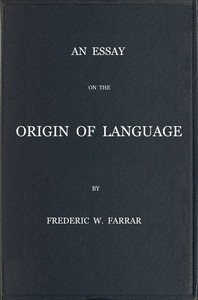
An essay on the origin of language, based on modern researches, and especially on the works of M. Renan — Edition Insights

(0 User reviews)   1204
In Category - Language Study
Farrar, F. W. (Frederic William), 1831-1903 Project Gutenberg 2020 Not confirmed
Renan, Ernest, 1823-1892; Language and languages Readers of public-domain and historical texts
Project Gutenberg digital edition en

Edition facts

Words 54,336
Reading time 237 min
Text sections 18

This digital edition of An essay on the origin of language, based on modern researches, and especially on the works of M. Renan — Edition Insights is described by source-level measurements including 54,336 words, 3 hr 57 min estimated reading time, and 18 detected text sections.

The text analysis averages about 21.8 words per sentence, while the detected sections provide another way to judge how the source is divided.

Project Gutenberg metadata also associates the work with “Renan, Ernest, 1823-1892,” connecting these edition facts with the source record’s subject description.

Farrar's 1860 essay examines language origins through the lens of Renan's work, critiquing materialist theories like Horne Tooke's while arguing for a non-materialist view of language and thought.
Share
Editorial Edition Score 4.8/5

Calculated from edition completeness, EPUB availability, text structure and catalogue metadata. Not a user rating.

How this score is calculated
  • Description quality20 pts
  • Title & short description10 pts
  • Source metadata20 pts
  • Text length15 pts
  • Chapters / structure15 pts
  • EPUB file integrity20 pts

Total of 100 points, scaled to a 2.5-5.0 range. Editions with an empty description or a missing EPUB file are not scored.

Edition quality

Read the Text

RIGIN OF LANGUAGE. PAGE The faculty of speech.--Definition of language.--Importance of philology.--Three main theories on the origin of language--1. That language was innate and organic.--Curious errors.--Objections to this view.--2. That language was the result of imitation and convention.--Objections.--3. That language was revealed.--In what sense this may be held to be true.--The phrase obscure, and leads to many misconceptions.--Danger of a misapplied literalism.--Five objections to the common belief.--The real meaning of Gen. ii. 19, 20.--Rightly understood it exactly accords with the true theory.--Germ of truth in each of these views. 1

THE PSYCHOLOGICAL DEVELOPMENT OF THE IDEA OF SPEECH.

Germinal development of language.--How came words to be accepted as signs?--The inquiry not absurd.--What is a word?--Words only express the relations of things.--Connection of thought and speech.--Growth of individuality.--Theory of M. Steinthal.--Speech depends on the power of abstraction; the transformation of intuitions into ideas.--1. Impressions awoke sounds.--2. Sounds, by the association of ideas, recalled impressions.--3. Sounds became words by connecting the external object and the inward impression.--Influence of organism.--Earliest impressions expressed by the simplest sounds.--Influence of women.--Influences of climate. 34

THE LAWS OF SPECIAL SIGNIFICANCE, OR THE CREATION OF ROOTS.

Words never _purely_ arbitrary.--They _become_ conventional in time.--Corruptions produced by the dislike of mechanical words.--Inappropriate corruptions.--Words, significant at first, are allowed to become conventional.--Grammar the _life_ of a language.--Onomatopœic or _imitative_ words.--_Motive_ of words.--Delicacy of the appellative faculty.--The imitation always purely artistic.--Instances of the spontaneous tact which gives rise to new names. 53

Sounds naturally used as the signs of sounds; as among infants, and savage races.--Wide application of this law overlooked.--The imitation modified organically and ideally.--Admirable perfection of the organs of sound.--Boundless capabilities of language.--Diversity of _relations_ gave rise to different imitations.--Roots universally onomatopœic.--Cause of dialectic variety.--Interjections and onomatopœia the two natural elements of language.--Instances of words derived from exclamations; and from imitation.--Supposed vulgarity of onomatopœic words.--Their real dignity when well used.--Instances from the poets.--They cannot be avoided.--Harmonies of language. 72

THE DEVELOPMENT OF ROOTS.

Roots supposed to be primitive and irreducible.--Words derived from sensible images; the personal pronouns; and even the numerals.--The verb ‘to be,’ in all languages, from a material root.--Permutations and combinations of a few roots.--Instances of their diffusiveness.--The root ‘ach.’--The root ‘dhu.’--The same root to express opposite meanings.--Roots refracted and reflected.--Important applications of these remarks. 97

We know nothing absolutely.--Language an asymptote.--Necessity of analogy to express things.--All words ultimately derivable from sensible ideas.--Instances in the Semitic languages.--Graphic effects thus produced.--Words involve all history.--Catachresis and metaphor.--Defence of both from the charge of imperfection.--Necessity, power, and value of metaphor.--Comparisons of style.--Rigid accuracy and clumsiness of scientific terminology.--Words are but symbols.--The two worlds.--Poetry of life to the primal man, and its influence on language.--A nation’s language expresses its character. 116

WORDS NOTHING IN THEMSELVES.

Inferences drawn from the derivation of all words from ‘sensible ideas.’--Gradual degeneracy of the Sensational School.--Condillac.--Helvetius.--The Diversions of Purley.--Real derivation of the words ‘If’ and ‘Truth.’--What words really stand for.--The conclusions of nominalism need not be accepted.--Reason.--Words which can only be explained by the idea. 147

THE LAWS OF PROGRESS IN LANGUAGE.

These laws psychological.--1. Languages advance from exuberance to moderation by eliminating superfluities.--Unity of speech the result of civilisation.--Redundancy marks an early stage of thought.--Superfluous words dropped or desynonymised.--2. Languages advance from indetermination to grammar.--Simplicity succeeds complexity.--Instances of agglutination.--3. Languages advance from synthesis to analysis.--Tmesis a relic of Polysynthetism.--Analysis not inferior to synthesis for the expression of thought.--Instances in the Indo-European and Semitic languages.--Grimm on the English language.--Some would add a 4th law, viz.: the progress from monosyllabism.--Arguments in favour of this law.--It remains very questionable; only a convenient hypothesis. 166

THE FAMILIES OF LANGUAGES.

Stages of Language.--The logical order not the historical.--1. The Indo-European and Arian family.--Its unity and importance.--Life of the early Arians.--“Linguistic Palæontology.”--2. The Semitic family.--Its character and divisions.--3. The Allophylian or Turanian (?) family (?).--Can only be called a ‘family’ hypothetically.--Includes a vast number of languages, which have _very little_ connection with each other. 185

ARE THERE ANY PROOFS OF A SINGLE PRIMITIVE LANGUAGE?

Farrar opens his essay by disclaiming originality, presenting himself as a clear expositor of distinguished philologists, especially Ernest Renan. He warns readers that his quotations are often abbreviated or transposed, urging against treating them as direct translations. This methodological caution sets the tone for a work that engages critically with contemporary theories of language origin.

The preface reveals Farrar's intended audience: young learners. He writes that the questions he handles have 'always been to me full of interest' and that he has 'invariably found that they are also full of interest to young learners.' This pedagogical aim shapes the essay's structure, which moves from summarizing Renan to confronting materialist philosophies of language.

Farrar's Critical Engagement with Materialism

In the middle excerpts, Farrar directly challenges materialist conclusions drawn from theories of language origin. He lists a series of questions: 'Must we say, with Condillac, that “science is only a well-constructed language?” or with M. Destutt de Tracy, that “thought is sensation?”' These queries show Farrar testing the logical consequences of materialist premises. He singles out Horne Tooke's Diversions of Purley for sustained critique, noting that Tooke's etymology of 'truth' as a contraction of 'troweth' leads to the claim that 'there is no such thing as eternal, immutable, everlasting truth.' Farrar counters by citing a philologist who called Tooke's work a 'mere castle in the air,' and he quotes Mr. Garnett's remark that 'the Delphian EI supported the tripod of truth; we fear that Tooke's if imperative led him into a labyrinth of error.'

The Role of Renan and Other Authorities

Farrar repeatedly acknowledges his debt to Renan, calling his treatises 'very clear, learned, and beautiful.' He also draws on Grimm and other German philologists. However, the excerpts show that Farrar does not simply summarize; he uses these authorities to build a case against reductive views of language. For instance, he notes that Tooke's system was 'overthrown' by Mr. Garnett's article on English Lexicography, which demonstrated that Tooke's analysis of particles 'may be contested more often than admitted.' Farrar's method is to present competing arguments, then weigh them through cited scholarship. This approach makes the essay a dialogue between materialist and idealist positions, with Renan serving as a touchstone for the latter.

Structure and Argumentative Strategy

The essay's structure emerges from its preface and the sampled middle chapters. Farrar begins by framing his work as unpretentious and derivative, yet the excerpts reveal a clear argumentative arc: he moves from summarizing Renan's views to attacking materialist etymologies. The attack on Tooke is detailed, with Farrar listing specific etymological errors—such as the claim that 'if' is an imperative of 'to give'—and citing counter-evidence from cognate forms in other languages. This forensic approach suggests that the full essay likely alternates between exposition and refutation. Farrar also uses rhetorical questions to force readers to consider the implications of materialist theories, asking whether they lead to 'no eternal right or truth.'

Evidence from the Excerpts: Voice and Recurring Details

Farrar's voice is scholarly but engaged, marked by parenthetical exclamation points—as in 'courage to be the fear of death (!)'—and direct addresses to the reader. He frequently uses metaphors: Tooke's system is a 'baseless fabric' and a 'castle in the air.' The excerpts also show Farrar's habit of citing multiple authorities in quick succession, creating a dense web of references. A recurring detail is his attention to etymology as a battleground for larger philosophical claims. For example, he traces Tooke's argument that 'truth' is merely 'what one troweth' and then shows how this leads to relativism. Farrar's own position is implied rather than stated: he defends the possibility of eternal truth against etymological reductionism.

Readers approaching Farrar's essay should attend to his dual strategy: he presents himself as a humble expositor while mounting a vigorous critique of materialist philology. The excerpts suggest that the full work is best read as a polemic disguised as a summary. Pay close attention to how Farrar uses footnotes and quotations—he often expands or transposes them, so checking his sources may reveal his interpretive slant. The essay rewards those who follow his argumentative thread from Renan's idealism to the refutation of Tooke's etymologies.

There’s something touching about Farrar’s old essay, how gently he resisted the idea that words are just mechanical things. It makes me think of the quiet hours I spent once with that other, plainer volume, How to Use the Popular Science Library; History of Science; General Index — Reading Notes, where even an index felt like a door left slightly ajar.

There are no reviews for this eBook.

0
0 out of 5 (0 User reviews )

Add a Review

Your Rating *
There are no comments for this eBook.

Reader reflection

Your personal reading reflection

Build a private reading journal entry for this title.

Your progress 0 / 10
1

Which reading stage best describes you?

2

Did this book hold your interest?

3

Would you encourage someone else to read it?

4

Did the language feel accessible?

Related eBooks