About 51 minutes
Index of the Project Gutenberg Works of Herman Melville — Story, Setting & Ideas
Language Study
11,683 recorded words. 1 minutes difference from this book's estimate.
View Gutenberg source #58477
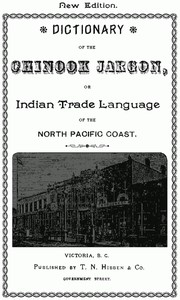
Dictionary of the Chinook Jargon, or Indian Trade Language, of the North Pacific Coast — A Closer Reading can be approached with a clearer sense of reading commitment from its source measurements: 11,324 words, 50 min estimated reading time, and 2 detected text sections.
The text analysis averages about 9.1 words per sentence, while the detected sections provide another way to judge how the source is divided.
Project Gutenberg metadata also associates the work with “Chinook jargon -- Glossaries, vocabularies, etc.,” connecting these edition facts with the source record’s subject description.
Explore this collection
These alternatives are selected using recorded categories and estimated reading time.
About 51 minutes
Language Study
11,683 recorded words. 1 minutes difference from this book's estimate.
View Gutenberg source #58477About 49 minutes
Language Study
11,069 recorded words. 1 minutes difference from this book's estimate.
View Gutenberg source #70082About 47 minutes
Language Study
10,770 recorded words. 3 minutes difference from this book's estimate.
View Gutenberg source #58249Search stored excerpts and compare books → Choose by your preferences →
Choices use stored catalog measurements. Estimates vary with reading speed. A shared category is a catalog label, not a claim that two books have the same argument or literary quality.
Search reads excerpt text stored with this catalog and links to its associated Gutenberg record. The connection is stored in the site database; this tool does not recheck that every excerpt is word-for-word identical to that external record. Excerpt search does not cover every chapter and does not verify historical publication dates.
Catalog snapshot checked: 2026-09-26. Coverage: 93 public books, 93 available source excerpts.
Calculated from edition completeness, EPUB availability, text structure and catalogue metadata. Not a user rating.
Total of 100 points, scaled to a 2.5-5.0 range. Editions with an empty description or a missing EPUB file are not scored.
Public-domain source text
The source text is kept in the dedicated reader, separate from this catalogue record and its commentary.
The 1889 Dictionary of the Chinook Jargon, published by T.N. Hibben & Co. in Victoria, B.C., presents a trade language used along the North Pacific Coast through a compact bilingual lexicon. The compilers made deliberate decisions about which words to include and how to represent them, shaping the reader’s understanding of this pidgin. The dictionary’s two-part structure—Chinook-to-English followed by English-to-Chinook—reflects a practical aim: to serve both English speakers encountering the jargon and those needing to translate from it.
Beyond simple word lists, the entries reveal the compilers’ attention to pronunciation, usage, and cultural context. The phonetic spellings, part-of-speech labels, and occasional example phrases offer clues about how the language was spoken and understood in the late 19th century.
The dictionary’s orthography is notably English-based, with hyphenated syllables meant to guide pronunciation. For instance, ahn-kut-te (formerly) includes a note that accent on the first syllable indicates “a long time ago.” Such diacritic-like instructions are rare in the text, making this entry an exception. More commonly, the compilers rely on familiar English letter combinations: chah-ko (to come), skookum (strong), tumtum (heart). The choice of ch for the /tʃ/ sound and sh for /ʃ/ follows English conventions, while tl in tl'kope (to cut) represents a lateral affricate unfamiliar to English speakers. The hyphenation likely served as a pronunciation aid for traders and settlers who were not linguists.
Each entry includes a part-of-speech label—n., v., adj., adv., interj.—but the grammar of Chinook Jargon is not described. The labels are applied inconsistently: ah-ha is labeled adv. (yes), while al-ah is labeled as an expression of surprise without a part of speech. Some verbs appear only in imperative or infinitive forms, such as mamook (to do, make) used as a prefix in mamook bloom (to sweep). The dictionary does not explain how tense, mood, or plurality are expressed, leaving the reader to infer from example phrases. This lack of grammatical explanation suggests the compilers assumed users already knew the language’s basic structure or would learn it through use.
The wordlist reflects the material culture and environment of the North Pacific Coast. Entries include canim (canoe), canim stick (cedar), salt chuck (sea), skookum chuck (rapid), and tumwater (cascade). Trade goods appear: chickamin (iron, metal), t'kope chikamin (silver), pil chickamin (gold or copper). Animals like chet-woot (black bear), siam (grizzly bear), and moosmoos (buffalo, cattle) show adaptation to local fauna. The inclusion of Boston illahie (United States) and King George (Englishman) reveals the political context of the fur trade era. The compilers also recorded interjections like anah (displeasure) and al-ah (surprise), capturing affective speech.
The transcriber’s note acknowledges that “some instances of inconsistent spellings were adjusted when found corrected in an alternate edition,” while others remain as in the original. For example, tsil tsil and chil-chil both appear for “buttons,” and olillie and olallie for “berries.” The entry for “clam” lists three variants: ona, lukutchee, and lakwitchee, with a separate entry for smetocks (large clams). Such variation may reflect dialectal differences or the compilers’ reliance on multiple informants. The dictionary does not standardize these forms, leaving the reader to navigate the fluidity of a spoken pidgin. The decision to preserve variant spellings, rather than enforce uniformity, suggests a documentary rather than prescriptive approach.
Readers approaching this dictionary should treat it as a historical artifact of a contact language, not a complete grammar. The compilers’ choices in spelling, labeling, and selection offer a window into how English speakers perceived and recorded Chinook Jargon. To use the dictionary effectively, cross-reference entries between the two parts and note variant forms. The example phrases, though sparse, provide the most direct evidence of usage. This work is best understood alongside ethnographic and historical accounts of the fur trade era.
That rainy afternoon, I kept returning to the tribal glossary’s patient, quirky recording of a vanished shared tongue—each entry a palimpsest of encounter. The work felt like a registry of human striving, part commerce, part misunderstanding. Later, nearly by chance, my hand found another index, Index of the Project Gutenberg Works of Sir Winston Spencer Churchill — Story, Setting & Ideas, and that same sense of catalogued momentum returned, though the words were louder.
A brief reflection can help important ideas stay with you longer.