About 393 minutes
Proverb Lore Many sayings, wise or otherwise, on many subjects, gleaned from many sources — A Reader’s Guide
Language Study
90,286 recorded words. 1 minutes difference from this book's estimate.
View Gutenberg source #34176
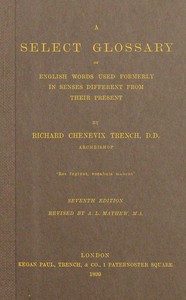
A select glossary of English words used formerly in senses different from their present — Key Ideas to Explore can be approached with a clearer sense of reading commitment from its source measurements: 90,604 words, 6 hr 34 min estimated reading time, and 22 detected text sections.
The text analysis averages about 16.2 words per sentence, while the detected sections provide another way to judge how the source is divided.
Project Gutenberg metadata also associates the work with “English language -- Semantics,” connecting these edition facts with the source record’s subject description.
Explore this collection
These alternatives are selected using recorded categories and estimated reading time.
About 393 minutes
Language Study
90,286 recorded words. 1 minutes difference from this book's estimate.
View Gutenberg source #34176About 389 minutes
Language Study
89,258 recorded words. 5 minutes difference from this book's estimate.
View Gutenberg source #2468About 381 minutes
Language Study
87,441 recorded words. 13 minutes difference from this book's estimate.
View Gutenberg source #73237Search stored excerpts and compare books → Choose by your preferences →
Choices use stored catalog measurements. Estimates vary with reading speed. A shared category is a catalog label, not a claim that two books have the same argument or literary quality.
Search reads excerpt text stored with this catalog and links to its associated Gutenberg record. The connection is stored in the site database; this tool does not recheck that every excerpt is word-for-word identical to that external record. Excerpt search does not cover every chapter and does not verify historical publication dates.
Catalog snapshot checked: 2026-09-26. Coverage: 93 public books, 93 available source excerpts.
Calculated from edition completeness, EPUB availability, text structure and catalogue metadata. Not a user rating.
Total of 100 points, scaled to a 2.5-5.0 range. Editions with an empty description or a missing EPUB file are not scored.
Public-domain source text
The source text is kept in the dedicated reader, separate from this catalogue record and its commentary.
Richard Chenevix Trench’s A Select Glossary does not merely list obsolete words; it exposes the drift of meaning that separates present-day English from its earlier forms. Each entry pairs a word with quotations—from Chaucer, Shakespeare, Wiclif, and others—that illustrate a former sense now lost or altered. The entry for ‘jolly,’ for instance, shows that it once meant ‘beautiful,’ a sense carried over from French ‘joli.’ Trench’s method is to let the quoted passages speak, often adding a brief remark on the social or linguistic forces behind the change. The result is a work that reads less like a dictionary and more like a series of miniature essays on how language evolves through use, misuse, and cultural shift.
Trench builds each entry around dated quotations, allowing the reader to see a word in action across centuries. For ‘knave,’ he cites Wiclif’s translation of Exodus (‘a knave child’) and Shakespeare’s Julius Caesar (‘gentle knave’), where the word simply means ‘boy’ or ‘servant.’ The shift to ‘dishonest person’ is inferred from the contexts: Trench notes that ‘many serving-lads must have been unfaithful and dishonest before “knave” acquired its modern meaning.’ He does not assert a single cause but points to a pattern visible in German cognates like ‘Bube’ and ‘Schalk.’ The quotations are chosen to span genres—biblical translation, poetry, drama, and prose—giving a broad view of usage.
Several entries reveal how words absorbed ethical judgments over time. ‘Kindly,’ Trench explains, originally meant simply ‘of the same kind’ or ‘natural,’ with no moral connotation. He quotes Wiclif’s ‘kyndeli sone of God’ and Andrewes’s ‘kindly brood of the Man of sin’ to show the neutral sense. Only later did the word acquire its modern sense of ‘benevolent.’ Trench’s comment—‘it is God’s ordinance that “kind” should be “kindly”’—suggests a teleological view of language, as if meaning naturally gravitates toward moral goodness. This interpretive stance is characteristic: Trench often implies that semantic change reflects broader cultural or religious truths, though he grounds each claim in textual evidence.
Some words have narrowed from general physical reference to specific body parts. ‘Knuckle,’ Trench notes, once meant any joint, as in Golding’s translation of Ovid: ‘With weary knuckles on thy brim she kneeled.’ The word now refers almost exclusively to the finger joints. Similarly, ‘lace’ (not fully excerpted) likely traces a path from a cord or string to the decorative fabric. Trench’s method is to highlight such narrowing without over-explaining; he trusts the quotations to show the older, broader sense. The entry for ‘knuckle’ includes Milton’s ‘maukin knuckles,’ a phrase that would puzzle a modern reader without the gloss. These physical terms demonstrate how language can lose specificity even as it gains precision in other domains.
The seventh edition, revised by A. L. Mayhew in 1890, preserves Trench’s original preface but adds updated references and corrections. Mayhew’s role is evident in the inclusion of later sources, such as the 1665 pamphlet Jus Populi Vindicatum under ‘kindly.’ The preface, written by Trench for the first edition, outlines his pedagogical aim: to offer a substitute for classical language training by decomposing English poetry and prose. He singles out Milton’s Lycidas and Bacon’s essays as ideal texts for this exercise. Mayhew’s revisions ensure that the glossary remains useful for late-Victorian readers, but the core method—tracing semantic change through illustrative quotations—remains Trench’s. The collaboration between author and editor gives the work a layered texture, blending two scholarly voices across decades.
Trench’s glossary rewards readers who approach it as a collection of case studies rather than a reference tool. The entries are short enough to browse, but the cumulative effect is a deepened awareness of how words carry history. For anyone reading older English texts, this book offers a practical key to passages that might otherwise mislead. It also invites reflection on the words we use today: which of them will shift meaning in the next century, and what will that say about us?
There’s something tender about watching old words drift, like jolly once meaning proud and brave, and I found that same quiet ache in the Repertory of The Comedie Humaine, Part 1 — Edition Insights, where names and places hold histories we no longer quite see. It lingered with me gently, a familiar sadness of things shifting underneath us.
Build a private reading journal entry for this title.