About 264 minutes
Duality of Voice — Reading Companion
Language Study
60,655 recorded words. 21 minutes difference from this book's estimate.
View Gutenberg source #48486
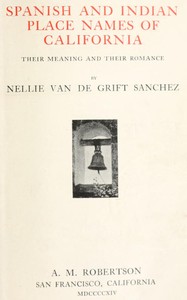
The source record for Spanish and Indian place names of California: Their Meaning and Their Romance — Text and Context measures this digital text at 65,542 words, 4 hr 45 min estimated reading time, and 11 detected text sections.
The text analysis averages about 17.3 words per sentence, while the detected sections provide another way to judge how the source is divided.
Project Gutenberg metadata also associates the work with “California -- History, Local,” connecting these edition facts with the source record’s subject description.
Explore this collection
These alternatives are selected using recorded categories and estimated reading time.
About 264 minutes
Language Study
60,655 recorded words. 21 minutes difference from this book's estimate.
View Gutenberg source #48486About 246 minutes
Language Study
56,403 recorded words. 39 minutes difference from this book's estimate.
View Gutenberg source #48907About 326 minutes
Language Study
74,853 recorded words. 41 minutes difference from this book's estimate.
View Gutenberg source #33197Search stored excerpts and compare books → Choose by your preferences →
Choices use stored catalog measurements. Estimates vary with reading speed. A shared category is a catalog label, not a claim that two books have the same argument or literary quality.
Search reads excerpt text stored with this catalog and links to its associated Gutenberg record. The connection is stored in the site database; this tool does not recheck that every excerpt is word-for-word identical to that external record. Excerpt search does not cover every chapter and does not verify historical publication dates.
Catalog snapshot checked: 2026-09-26. Coverage: 93 public books, 93 available source excerpts.
Calculated from edition completeness, EPUB availability, text structure and catalogue metadata. Not a user rating.
Total of 100 points, scaled to a 2.5-5.0 range. Editions with an empty description or a missing EPUB file are not scored.
Public-domain source text
The source text is kept in the dedicated reader, separate from this catalogue record and its commentary.
Nellie Van de Grift Sanchez’s study of California place names is built on a tension between two naming traditions: the Spanish missionary impulse to christen landscapes after saints and the older, often opaque Indian names that resisted easy translation. The book’s epigraph from Robert Louis Stevenson—praising American nomenclature as “rich, poetical, humorous, and picturesque”—sets a romantic tone, yet the text itself frequently confronts the difficulty of pinning down meanings. For instance, the entry for Sonoma presents competing explanations: one deriving it from the Indian tso-noma (“earth village”), another from a chief’s prominent nose (sono plus ma for “valley”). Sanchez does not settle the dispute but lets both versions stand, highlighting the layers of interpretation that accumulate over time.
Many Spanish place names in California originated with the mission system, yet Sanchez shows that the link between a saint’s name and the location was often indirect. The town of San Quintín, she notes, was probably not named directly for the Roman soldier-saint but “received the name indirectly from Point Quintín, on the Marin coast, which was so-called from an Indian chief … who had been thus christened by the Spaniards.” This pattern recurs: a saint’s name passes through indigenous intermediaries, acquiring new associations. Similarly, San Ramón’s entry recounts the gruesome story of St. Raymond’s lips being “bored through with a red-hot iron, and fastened with a padlock”—a detail drawn from hagiography that seems remote from the Contra Costa town. Sanchez’s method is to juxtapose such saintly lore with the mundane geography, leaving the reader to gauge the distance between the two.
When Sanchez turns to Indian-derived names, the text becomes more tentative. Tocaloma, she writes, is “Indian, but its meaning has not been ascertained.” Tomales Bay is traced to a Spanish corruption of the Indian tamal (bay), a word that “came to be applied to the natives in the neighborhood of San Francisco Bay.” Here the name shifts from a geographical feature to an ethnic label, a transformation Sanchez records without commentary. The entry for Sonoma is the most elaborate: she cites both academic sources (University of California publications) and local memory (Dr. Vallejo’s memoirs), presenting the “earth village” etymology alongside the “nose valley” story. The effect is to show that Indian names are not fixed data but contested ground, where linguistic analysis and anecdote compete for authority.
Sanchez devotes unusual space to the Vallejo surname, quoting Bancroft’s praise of Mariano Guadalupe Vallejo as a figure of “honorable conduct, patriotic zeal, executive ability, and freedom from petty prejudices.” The name Vallejo appears as a place in Solano County, but the book’s treatment extends beyond etymology into biography: Ignacio Vicente Ferrer Vallejo, “of pure Spanish blood, and of superior education,” founded the family, and his son Mariano “foresaw the fate of his country, and finally cast in his lot with the United States, for which he seems to have been but ill-repaid.” This digression reveals how a place name can become a portal to a personal and political story. Sanchez’s willingness to include such narratives—alongside saint’s legends and linguistic puzzles—makes the book less a dry gazetteer than a collection of interlocking histories.
Readers should approach this work as a layered document: part reference, part anthology of California lore, part record of early twentieth-century scholarship. Sanchez draws on academic authorities like Herbert E. Bolton and A. L. Kroeber, but also on local informants and published memoirs. The result is a text where certainty and speculation coexist. For those tracing the origins of a particular name, it is worth checking both the main entry and the index, as meanings are sometimes revised or supplemented in later sections.
There’s something tender about a name holding a story we’ve forgotten, the way Spanish and Indian Place Names of California brushes dust off old words. It reminds me of leafing through the Index of the Project Gutenberg Works of Anatole France — Edition Insights—not reading, just touching the edges of someone’s collected quiet, wondering who first said these things aloud.
Your answers remain private and are stored only in this browser.