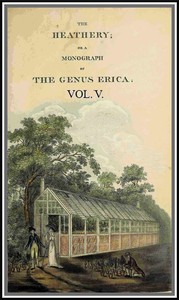
The heathery; or, A monograph of the genus Erica. vol. 5 — A Reader’s Guide

(0 User reviews)   486
In Category - Language Study
Andrews, Henry Cranke, active 1799-1828 Project Gutenberg 2023 Not confirmed
Ericas; Ericas -- Pictorial works Readers of public-domain and historical texts
Project Gutenberg digital edition en

Edition facts

Words 9,756
Reading time 43 min
Text sections 3

This digital edition of The heathery; or, A monograph of the genus Erica. vol. 5 — A Reader’s Guide is described by source-level measurements including 9,756 words, 43 min estimated reading time, and 3 detected text sections.

The text analysis averages about 11.3 words per sentence, while the detected sections provide another way to judge how the source is divided.

Project Gutenberg metadata also associates the work with “Ericas,” connecting these edition facts with the source record’s subject description.

This editorial note examines H. C. Andrews's precise botanical descriptions in volume 5 of 'The heathery,' focusing on his consistent use of Latin and English paired entries, his attention to floral morphology, and the recurring geographical reference to the Cape of Good Hope.
Share
Editorial Edition Score 4.5/5

Calculated from edition completeness, EPUB availability, text structure and catalogue metadata. Not a user rating.

How this score is calculated
  • Description quality20 pts
  • Title & short description10 pts
  • Source metadata20 pts
  • Text length15 pts
  • Chapters / structure15 pts
  • EPUB file integrity20 pts

Total of 100 points, scaled to a 2.5-5.0 range. Editions with an empty description or a missing EPUB file are not scored.

Edition quality

Read the Text

LATIN AND ENGLISH DESCRIPTIONS, DISSECTIONS, ETC.

THE KNOWN SPECIES OF THAT EXTENSIVE AND DISTINGUISHED TRIBE OF PLANTS.

SECOND EDITION, CORRECTED AND ENLARGED.

LONDON: HENRY G. BOHN, YORK STREET, COVENT GARDEN. 1845.

ERICA Andromedæflora, _alba_.

Antheræ cristatæ, nigræ, inclusæ. Flores axillares, sub-terminales, declinati, conferti. Calyx magnus, lato-ovatus, albus. Corolla ovata, inflata, crassa, alba. Folia ternata, subulata, incurvata, robusta, obtusa, petiolis longis adpressis. Caulis humilis, fruticosus, robustus.

Tips crested, black, and within the blossom. Flowers grow from the axillæ of the leaves, nearly terminal, bending down, and crowded together. Empalement large, of a broad ovate form, and white. Blossom ovate, inflated, thick and white. Leaves by threes, awl-shaped, incurved, stout, and blunt, ended with long footstalks pressed to the branches. Stem low, shrubby, and strong.

Native of the Cape of Good Hope. In bloom from March till June.

1. The empalement. 2. A blossom. 3. The chives and pointal, one tip magnified. 4. Seed-bud and pointal, summit magnified.

Antheræ muticæ, inclusæ, stylo exserto. Flores horizontaliter verticillati prope ramorum summitatem. Corolla clavata, uncialis, oris laciniis patentibus. Folia sena, linearia, apice leviter incurvata, supra plana, subtus sulcata. Caulis fruticosus, erectus, sesquipedalis, ramis simplicibus.

Tips beardless, within the blossom: shaft without. Flowers grow horizontally in whorls near the summit of the branches. Blossom club-shaped, an inch long: segments of the border spreading. Leaves by sixes, linear, slightly turned inward towards the end, flat on their upper surface, and furrowed beneath. Stem shrubby, upright, a foot and a half high. Branches simple.

Native of the Cape of Good Hope. In bloom from June till October.

1. The empalement. 2. A chive magnified. 3. Seed-bud and pointal, summit magnified.

ERICA aristata, _minor_.

Antheræ muticæ, inclusæ. Flores quaterni, patentes. Corolla basi inflata, apice attenuata, rubra, glutinosissima et lucida. Folia ternata, subtrigona, supra plana, subtus sulco-exarata, marginibus pilis longis obsitis. Caulis erectus, fruticosus, pedalis et ultra, ramulis plerumque ternis verticillatis.

Tips beardless, within the blossom. Flowers grow by fours, spreading. The blossom is swelled at the base, tapering towards the end, red, very gummy and shining. Leaves by threes, nearly three-sided, flat on their upper surface, and deeply furrowed beneath: the margins are beset with long hairs. Stem upright, shrubby, a foot or more high. Branches grow mostly in whorls by threes.

Native of the Cape of Good Hope. In bloom from June till October.

1. Chives and pointal, one tip magnified. 2. Seed-bud and pointal, summit magnified. 3. Flower of a red variety. 4. Flower of a pale variety.

ERICA aurea, _Var. flore pallido_.

Antheræ muticæ, sub-inclusæ. Flores horizontaliter verticillati, prope ramorum summitatem. Pedunculi brevissimi. Corolla cylindracea, luteolo-aurea, apice inflata: oris laciniis magnis, albis. Folia sena, linearia, patentia, apice incurvata. Caulis erectus, fruticosus, pedalis.

Tips beardless, and just within the blossom. Flowers grow horizontally in whorls near the summit of the branches. Footstalks very short. Blossom cylindrical, of a yellow gold colour, swelled at the end: segments of the border large and white. Leaves by sixes, linear, spreading, and turned inwards at the point. Stem upright, shrubby, a foot high.

Native of the Cape of Good Hope. In bloom from June till October.

1. The empalement magnified. 2. Chives and pointal, one tip magnified. 3. Seed-bud and pointal, summit magnified.

Antheræ muticæ, inclusæ, stylo exserto. Flores terminant ramos in umbellis quinque ad decem, cum pedunculis longissimis rubris: corollis urceolatis: oris laciniis patentibus, æqualibus. Folia terna, trigona, subulata, supra plana, subtus carinata. Caulis pedalis, fruticosus.

Tips beardless, within the blossom, shaft without. Flowers terminate the branches in umbels of five to ten, with very long red footstalks. Blossoms pitcher-shaped: segments of the border spreading and equal. Leaves by threes, three-sided, and awl-shaped, flat on the upper surface, and keeled beneath. Stem a foot high, and shrubby.

Native of the Cape of Good Hope. In bloom from July till September.

1. The empalement. 2. Chives and pointal, one tip magnified. 3. Seed-bud and pointal, summit magnified.

Antheræ muticæ, inclusæ: flores solitarii, penduli, in medio ramorum spicam laxam formantes: pedunculi longi, colorati, bracteis tribus infra minutis: corolla metulæformis, rubro-purpurea, laciniis exiguis, erectis, luteis: folia terna, linearia, arcuata, acuta, glabra, fasciculata: caulis erectus, fragilis, sesquipedalis, fruticosus: ramulis numerosis.

Tips beardless, within the blossom: flowers grow singly, hanging down, and forming a loose spike about the middle of the branches: footstalks long, and coloured with three minute floral leaves on the lower part: blossom skittle-shaped, and of a red purple; the segments of the border small, upright, and yellow: leaves by threes, linear, bowed, pointed, smooth, and bundled together: stem upright, brittle, a foot and a half high, and shrubby: small branches numerous.

Native of the Cape of Good Hope. In bloom during the autumnal months.

1. The empalement. 2. The seed-bud, chives, and pointal, one tip magnified. 3. Seed-bud and pointal, summit magnified.

H. C. Andrews's The heathery; or, A monograph of the genus Erica, volume 5, presents each species through a paired Latin and English description, a structure that reflects the scientific conventions of early 19th-century botany. The English descriptions are notably consistent in their terminology—terms such as 'tips,' 'empalement,' and 'pointal' recur across entries, indicating a deliberate technical vocabulary. Andrews also includes precise measurements (e.g., 'an inch long,' 'a foot and a half high') and details of leaf arrangement, such as 'by threes' or 'by sixes,' which ground the text in observable morphology.

The Bilingual Structure of Description

Each entry in this volume opens with a Latin Descriptio followed by an English Description. The two are not exact translations; the English often expands or clarifies the Latin. For instance, Erica argentiflora is described in Latin as 'Flores horizontaliter verticillati prope ramorum summitatem,' which the English renders as 'Flowers grow horizontally in whorls near the summit of the branches.' The English adds the phrase 'in whorls,' making the arrangement explicit. Similarly, Erica aristata, minor has 'corolla basi inflata, apice attenuata, rubra, glutinosissima et lucida' in Latin, while the English specifies 'The blossom is swelled at the base, tapering towards the end, red, very gummy and shining.' This pattern suggests Andrews aimed for precision in both languages, but the English version often provides a more accessible description for the non-specialist reader.

Recurring Terminology and Its Implications

Andrews employs a fixed set of English terms across species. 'Tips' consistently refers to the anthers, 'empalement' to the calyx, and 'pointal' to the pistil. This uniformity suggests a deliberate effort to standardize botanical English at a time when terminology was still fluid. For example, in Erica Andromedæflora, alba, the 'tips' are described as 'crested, black, and within the blossom,' while in Erica pumila, they are 'crested, within the blossom.' The repetition of 'crested' and 'within the blossom' across entries indicates a systematic approach to describing anther position and ornamentation. Such consistency aids the reader in comparing species, but it also reveals the limits of Andrews's descriptive palette—he rarely deviates from these core terms.

The Role of the Cape of Good Hope

Every species in the excerpts is noted as 'Native of the Cape of Good Hope.' This geographical refrain underscores the region's significance as a hotspot for Erica diversity. Andrews does not elaborate on the environment or climate, but the repeated mention of the Cape implies a shared origin for these plants. The flowering months vary—from March to June for Erica Andromedæflora, alba to December to June for Erica regerminans—suggesting that Andrews recorded phenological data specific to cultivation in England, not the Cape's natural season. The reader is left to infer that these heaths were likely grown in British greenhouses, a common practice for exotic plants in the 1840s.

Visual and Structural Cues in the Descriptions

Andrews's descriptions often include visual details that hint at the accompanying engravings. For Erica rugosa, the blossom is 'club-shaped, spreading, wrinkly, and of a deep red colour,' while the leaves are 'in irregular whorls of 3 to 5.' Such specificity would guide the reader's eye to the plate. The 'Reference' sections list numbered parts—'1. The empalement. 2. A blossom. 3. The chives and pointal'—creating a direct link between text and image. This integration of verbal and visual information is central to the monograph's purpose. Andrews also notes unusual features, such as the 'very gummy and shining' blossom of Erica aristata, minor, which would be difficult to convey in black-and-white engraving, suggesting the color plates were essential for capturing such textures.

Readers approaching this volume should attend to the interplay between Latin and English, as well as the recurring descriptive patterns. The text is not a narrative but a systematic catalogue, best used alongside the plates. Andrews's choices in terminology and structure reveal a botanist committed to clarity and consistency, even if his English sometimes feels archaic. For those interested in the history of botanical description, this volume offers a window into the taxonomic practices of the mid-19th century.

I’ve spent long afternoons with Andrews’s heaths, each Latin name a small door to the Cape’s windy slopes. The same patient quiet lives in this old proverb collection, where Dutch and Danish phrases sit side by side, each a pressed flower from a distant garden. Both feel like whispered agreements between strangers. A Polyglot of Foreign Proverbs Comprising French, German, Dutch, Spanish, Portuguese and Danish, with English Translations and a General Index — Story, Setting & Ideas holds that same gentle certainty.

There are no reviews for this eBook.

0
0 out of 5 (0 User reviews )

Add a Review

Your Rating *
There are no comments for this eBook.

Reader reflection

How did this book work for you?

Your answers remain private and are stored only in this browser.

Your progress 0 / 10
1

What is your current status with this title?

2

How did the book work for you overall?

3

Would you encourage someone else to read it?

4

Did the language feel accessible?

Related eBooks