About 82 minutes
Dictionary of the Chinook Jargon, or, Trade Language of Oregon — Inside the Classic
Philology
18,843 recorded words. 170 minutes difference from this book's estimate.
View Gutenberg source #15672
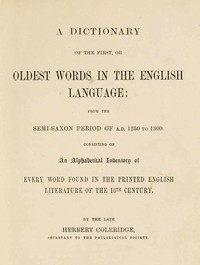
The catalog record for A Dictionary of the First or Oldest Words in the English Language From the Semi-Saxon Period of A.D. 1250 to 1300 — Reading Companion provides practical reading context through 57,896 words, 4 hr 12 min estimated reading time, and 12 detected text sections.
The text analysis averages about 5.5 words per sentence, while the detected sections provide another way to judge how the source is divided.
Project Gutenberg metadata also associates the work with “English language -- Middle English, 1100-1500 -- Glossaries, vocabularies, etc.,” connecting these edition facts with the source record’s subject description.
Explore this collection
These alternatives are selected using recorded categories and estimated reading time.
About 82 minutes
Philology
18,843 recorded words. 170 minutes difference from this book's estimate.
View Gutenberg source #15672About 39 minutes
Philology
8,810 recorded words. 213 minutes difference from this book's estimate.
View Gutenberg source #74756About 24 minutes
Philology
5,300 recorded words. 228 minutes difference from this book's estimate.
View Gutenberg source #10040Search stored excerpts and compare books → Choose by your preferences →
Choices use stored catalog measurements. Estimates vary with reading speed. A shared category is a catalog label, not a claim that two books have the same argument or literary quality.
Search reads excerpt text stored with this catalog and links to its associated Gutenberg record. The connection is stored in the site database; this tool does not recheck that every excerpt is word-for-word identical to that external record. Excerpt search does not cover every chapter and does not verify historical publication dates.
Catalog snapshot checked: 2026-09-26. Coverage: 93 public books, 93 available source excerpts.
Calculated from edition completeness, EPUB availability, text structure and catalogue metadata. Not a user rating.
Total of 100 points, scaled to a 2.5-5.0 range. Editions with an empty description or a missing EPUB file are not scored.
Public-domain source text
The source text is kept in the dedicated reader, separate from this catalogue record and its commentary.
Herbert Coleridge's A Dictionary of the First or Oldest Words in the English Language (1862) is not a reading companion but a philological instrument: an alphabetical inventory of every word found in printed English literature from the 13th century. The work is explicitly a foundation stone for the Philological Society's proposed historical dictionary, designed to give independent collectors a common standard for what to extract or reject from early texts. Coleridge assumes English literature, as distinct from Semi-Saxon, begins around the mid-13th century, and he organizes entries under modern word forms while preserving older spellings and cross-references.
The dictionary's arrangement is practical rather than narrative. Words are listed alphabetically under their modern equivalents, but older forms—such as ympne for hymn or ydle for isle—also appear as separate entries with cross-references. Obsolete words are entered exactly as they appear in the source passage. This dual-entry system allows a reader to locate a word whether they encounter it in its medieval spelling or its modern shape. Coleridge explains that the work is meant to be a standard of comparison, not a complete lexicon; it provides a controlled vocabulary for extractors who are gathering raw material for the larger dictionary project.
Each entry typically includes the part of speech, a brief definition, a source abbreviation (such as RG, HD, Alys, or Ps), and often a line number or folio reference. Etymological notes are added when useful, indicating the nearest cognate in Old English, Old Norse, or French. For example, meed is glossed with its Old English form méd, while medlay (meaning tumult or conflict) is traced to French medlée. Some entries include variant spellings: merry appears as miri and murdly, with comparative murgore and superlative murgost. These details reveal the phonetic and orthographic fluidity of 13th-century English.
The dictionary draws on a defined corpus of printed 13th-century works, including Robert of Gloucester's Chronicle (RG), Havelok the Dane (HD), King Horn, Owl and Nightingale (O. and N.), Alexander (Alys), and the Psalter (Ps). Each entry cites one or more of these sources, allowing a reader to trace a word's usage across different genres—chronicle, romance, debate poem, biblical translation. For instance, meet (meaning fit or proper) appears in Wright's L. P. and is also noted with an Old English cognate. The cross-referencing of forms like imeind (past participle of mein, to mingle) shows how the dictionary functions as a map of textual connections.
Coleridge adds a measured amount of etymological and explanatory material to make the work more than a bare index. He notes that while the primary purpose is to list words, the additional context may render the glossary more generally useful. For example, under mercy he records the phrase 'to do into mercy' meaning 'to force a man to beg his life,' citing RG line 539. Under menske he explains the semantic shift from Old English mennisc (human) to the senses of graciousness and civility. These annotations are sparse but pointed, offering glimpses into the social and literary contexts of the words without overloading the entries.
Coleridge's dictionary is best approached as a reference tool rather than a continuous read. Readers interested in the development of English vocabulary will find it useful to compare entries for the same word across different sources, noting shifts in spelling and meaning. The work's value lies in its systematic recording of a specific linguistic moment—the transition from Semi-Saxon to Middle English—and in its methodical linking of word forms to their textual evidence.
There’s something humbling about a glossary that stops at 1300, as if language itself were a slow river we only glimpse mid-current. It makes me think of the Dictionary of the Chinook Jargon, or, Trade Language of Oregon — Inside the Classic, another book that preserves words spoken between strangers, now mostly silent. Both feel like old postcards—stamped, faded, still quietly legible.
Create a short personal record of your experience with this book.