About 2,076 minutes
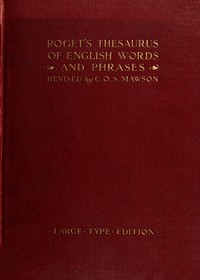
Roget's Thesaurus of English Words and Phrases — Text and Context
Philology
477,417 recorded words. 319 minutes difference from this book's estimate.
View Gutenberg source #10681
The catalog record for The Gutenberg Webster's Unabridged Dictionary: Section I, J, K, and L — Key Ideas to Explore provides practical reading context through 404,005 words, 29 hr 17 min estimated reading time, and 56 detected text sections.
The text analysis averages about 11.2 words per sentence, while the detected sections provide another way to judge how the source is divided.
Project Gutenberg metadata also associates the work with “English language -- Dictionaries,” connecting these edition facts with the source record’s subject description.
Explore this collection
These alternatives are selected using recorded categories and estimated reading time.
About 2,076 minutes
Philology
477,417 recorded words. 319 minutes difference from this book's estimate.
View Gutenberg source #10681About 2,123 minutes
Philology
488,242 recorded words. 366 minutes difference from this book's estimate.
View Gutenberg source #663About 2,228 minutes
Philology
512,336 recorded words. 471 minutes difference from this book's estimate.
View Gutenberg source #660Search stored excerpts and compare books → Choose by your preferences →
Choices use stored catalog measurements. Estimates vary with reading speed. A shared category is a catalog label, not a claim that two books have the same argument or literary quality.
Search reads excerpt text stored with this catalog and links to its associated Gutenberg record. The connection is stored in the site database; this tool does not recheck that every excerpt is word-for-word identical to that external record. Excerpt search does not cover every chapter and does not verify historical publication dates.
Catalog snapshot checked: 2026-09-26. Coverage: 93 public books, 93 available source excerpts.
Calculated from edition completeness, EPUB availability, text structure and catalogue metadata. Not a user rating.
Total of 100 points, scaled to a 2.5-5.0 range. Editions with an empty description or a missing EPUB file are not scored.
Public-domain source text
The source text is kept in the dedicated reader, separate from this catalogue record and its commentary.
Noah Webster's 1913 Unabridged Dictionary, as digitized in this Project Gutenberg edition, reveals a lexicographer deeply attentive to the historical layers of English. The entries for I, J, K, and L demonstrate a method that balances etymological rigor with practical usage notes. Webster traces the letter I from Phoenician through Latin and Greek, noting its original value 'nearly the same as that of the Italian I, or long e as in mete.' He also documents the dot over the lowercase i as a 14th-century innovation, a detail that grounds the dictionary in historical linguistics rather than mere definition.
Webster's entries consistently reach beyond English to establish cognates across Indo-European languages. For the pronoun 'I,' he lists Old English ic, Gothic ik, Latin ego, Greek egō, and Sanskrit aham, concluding with a cross-reference to 'Egoism.' This comparative approach is not merely decorative; it reflects Webster's belief that a dictionary should reveal the genetic relationships among words. Similarly, the entry for 'iambic' defines the metrical foot as 'a short syllable followed by a long one' and immediately supplies the Greek source iambikos. Such etymological chains are a hallmark of this edition, offering readers a window into the deep history of English vocabulary.
Webster devotes considerable space to the sounds of the letter I, distinguishing five principal vowel sounds: the long as in 'pine,' short as in 'pin,' the e-like sound in 'thirst,' the foreign e in 'machine,' and the consonantal y in 'bunion.' He also references the 'Guide to Pronunciation, §§ 98-106' for further detail. This systematic treatment of pronunciation is a key feature of the dictionary, aiming to standardize spoken English. The entry for 'jewel' includes a pronunciation guide for the verb forms 'jeweled' or 'jewelled,' showing Webster's attention to variant spellings and their phonetic implications. Such details make the dictionary a valuable resource for historical phonetics.
Webster enlivens definitions with quotations from canonical authors, demonstrating usage in context. Under 'jewel' as a verb, he cites Matthew Arnold: 'The long gray tufts . . . are jeweled thick with dew.' This poetic example not only clarifies the verb's meaning but also shows its figurative application. The entry for 'Jew's-harp' includes a note on the instrument's alternative name 'Jew's-trump' and a nautical sense as 'the shackle for joining a chain cable to an anchor.' Such multiple definitions, supported by quotations from Shakespeare and Sir Walter Scott, illustrate the dictionary's breadth. Webster's choice of quotations often reflects literary and practical domains, from poetry to seamanship.
The dictionary's structure reveals careful planning. Entries for compound terms like 'jib boom,' 'jib crane,' and 'jib door' are nested under the main entry 'jib,' with each sub-entry defined and cross-referenced. The entry for 'Jew's-harp' includes a parenthetical etymology: 'Jew + harp; or possibly a corrupt. of jaw's harp; cf. G. maultrommel, lit., mouthdrum.' This shows Webster's willingness to propose alternative origins. The inclusion of obsolete forms, such as 'Jewise' marked '[Obs.] Chaucer,' indicates a historical scope that traces words through their life cycles. Such organizational choices make the dictionary not just a reference but a map of the English language's evolution.
Readers approaching this dictionary should note that it is a snapshot of early 20th-century lexicography, with entries that blend scientific etymology with literary taste. The Project Gutenberg edition preserves the original typography and formatting, including the use of brackets and abbreviations. For those interested in the history of English, this volume offers a rich field of study, revealing how one influential lexicographer understood and presented the language of his time.
That rainy afternoon, I got lost in Webster’s quiet precision for the letter L, tracing how each word carried its own fossilized history. The definitions felt like stepping stones, and I found myself craving a different kind of order—not alphabetical, but associative. So I picked up Roget's Thesaurus — A Closer Reading, and the rain seemed to slow, matching the gentle turn of ideas into neighbors.
Your answers remain private and are stored only in this browser.