Aztec place-names — Key Ideas to Explore
Edition facts
This digital edition of Aztec place-names — Key Ideas to Explore is described by source-level measurements including 8,810 words, 39 min estimated reading time, and 5 detected text sections.
The text analysis averages about 11.5 words per sentence, while the detected sections provide another way to judge how the source is divided.
Project Gutenberg metadata also associates the work with “Nahuatl language -- Etymology -- Names,” connecting these edition facts with the source record’s subject description.
Calculated from edition completeness, EPUB availability, text structure and catalogue metadata. Not a user rating.
How this score is calculated
- Description quality20 pts
- Title & short description10 pts
- Source metadata20 pts
- Text length15 pts
- Chapters / structure15 pts
- EPUB file integrity20 pts
Total of 100 points, scaled to a 2.5-5.0 range. Editions with an empty description or a missing EPUB file are not scored.
Read the Text
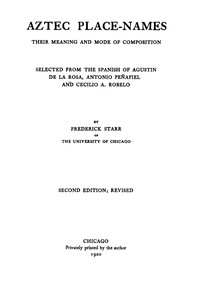
THEIR MEANING AND MODE OF COMPOSITION
SELECTED FROM THE SPANISH OF AGUSTIN DE LA ROSA, ANTONIO PEÑAFIEL AND CECILIO A. ROBELO
BY FREDERICK STARR OF THE UNIVERSITY OF CHICAGO
SECOND EDITION; REVISED
CHICAGO Privately printed by the author 1920
Before trying to understand Aztec hieroglyphic writing the student should gain some ideas as to how Mexican words are constructed and what changes word elements suffer in being compounded. No words are more interesting or suggestive in this direction than geographical names. This is particularly true because the hieroglyphic material most conveniently accessible to the student chances to be a list of place-names. The method of study we borrow from de la Rosa’s little work _Explicacion de algunos de los Nombres de la Lengua Mexicana_. His mode of analysis and presentation is direct and simple. De la Rosa’s arrangement has been followed in detail. The name is first presented in full; the meaning is then given in bracketed print; the elements are then presented, parts which are dropped in the compound being italicized; the meaning of each element is given in parenthesis; suggestions or explanation of special points are added in some cases. The list of Rules of Composition is taken from Dr. Antonio Peñafiel. Robelo is generally followed in questions of meaning.
The student is expected to learn the rules, to learn the meanings of the place-names, and to study the analyses sufficiently to be able to explain the construction of any name given in the list. After this material has been mastered additional exercises in sight-reading and analysis of new place-names should be undertaken.
CHICAGO, JUNE 21, 1920
RULES OF COMPOSITION FOLLOWED IN THE MAKING OF AZTEC PLACE-NAMES--(_After A. Peñafiel._)
1. Geographic names commonly end in some special particle indicative of place, as _co_, _e. g._--Anal-co.
2. When a particle indicative of place is added to a noun, the singular form of the noun only is used, even when it carries a plural force.
3. When a particle indicative of place is added to a noun, the noun is usually modified--generally dropping its terminal letters or syllable, _e. g._--Anahuac from a_tl_, nahuac.
4. When more than one noun are compounded before the particle indicative of place, each commonly drops its final letters or syllable, _e. g._--Coacalco from Coa_tl_, cal_li_, co.
5. For sake of euphony some nouns in composition may remain entire, _e. g._--Tzinacanoztoc from tzinacan, ozto_tl_, c.
6. Not more than three elements or words besides the postposition occur in geographic names.
7. When two nouns only are compounded into a place-name, the first loses its final letters or last syllable, while the second remains entire. The first is a qualifier of the second and follows it in translation, _e. g._--Tecalli from te_tl_, calli = “house (calli) of stone (tetl).”
8. In place-names compounded of an adjective and a noun, the adjective precedes, _e. g._--Iztacuauhtli from izta_c_, cuauhtli = “the white (iztac) eagle (cuauhtli).”
9. In place-names compounded of a noun and a verb, the noun precedes, _e. g._--Cacalomacan from cacalo_tl_, ma, can = “where they hunt (ma) crows (cacalotl).”
10. In place-names compounded of a numeral and a noun, the numeral precedes, _e. g._--Macuilxochic from macuil_li_, xochi_tl_, c. Macuilli (five).
LIST OF AZTEC PLACE-NAMES
~Acalhuacan.~ [Place of those who have canoes.] Compounded of acal_li_ (canoe); hua, which is a possessive particle; can (place).
~Acamilixtlahuacan.~ [Where are level fields of rushes.] Compounded of aca_tl_ (reed); mil_li_ (field); ixtlahua_ca_ (level expanse); can (place).
~Acamiltzinco.~ [Place of small fields of rushes.] Compounded of aca_tl_ (rush); mil_li_ (field); tzin_tli_, diminutive particle; co (place).
~Acapan.~ [Place of rushes.] Compounded of aca_tl_ (reed, rush); pan (place).
~Acapetlatlan.~ [Place of rush mats.] Compounded of aca_tl_ (rush, reed); petla_tl_ (mat); tlan (place of abundance).
~Acapolco.~ [Where the rushes were destroyed.] Compounded of aca_tl_ (rush); pol_oa_ (to destroy, to lose); co (place).
~Acatepec.~ [In the mountain of reeds.] Compounded of aca_tl_ (reed); tepe_tl_ (mountain); c (in).
~Acaticpac.~ [Over (or above) the canes.] Compounded of acat_l_ (cane); icpac (above).
~Acatzinco.~ [Place of small rushes.] Compounded of aca_tl_ (rush); tzin_tli_, diminutive particle; co (place).
~Acatzochic.~ [In the flowers of the cane.] Compounded of acat_l_ (cane); xochi_tl_ (flower); c (in).
~Acatzochitlan.~ [Among the flowers of the cane.] Compounded of aca_tl_ (cane); xochi_tl_ (flower); tlan (among).
~Acayocan.~ [Place full of canes, or rushes.] Compounded of acayu_tl_ (full of canes); can (place). Acayutl = aca_tl_ (cane) and yutl (full of).
~Acazacatla.~ [Where is abundance of rushes and straw.] Compounded of aca_tl_ (rush); zaca_tl_ (grass, straw); tla (abundance).
~Acocozpan.~ [In the very yellow water.] Compounded of a_tl_ (water); cocoz_tic_ (very yellow); pan (in, place).
Frederick Starr's Aztec Place-Names (1920) is a compact linguistic primer that dissects the construction of Nahuatl geographic names. Rather than offering a narrative, the book presents a systematic analysis: each entry lists a place-name, its meaning in brackets, and the component parts with their individual glosses. The preface frames the work as a tool for students of Aztec hieroglyphic writing, emphasizing that understanding word composition is a prerequisite. The method is borrowed from Agustín de la Rosa's Explicacion de algunos de los Nombres de la Lengua Mexicana, with meanings largely following Cecilio A. Robelo and composition rules drawn from Antonio Peñafiel.
Rules of Composition as a Structural Backbone
The book opens with seven rules of composition, attributed to Peñafiel, that govern how Nahuatl place-names are formed. These rules are not merely decorative; they are the analytical lens through which every subsequent entry is examined. Rule 1 states that geographic names commonly end in a particle indicating place, such as -co. Rule 3 notes that when such a particle is added, the noun usually drops its terminal letters or syllable—for example, Anahuac from atl (water) and nahuac (near). Rule 6 limits compounds to three elements plus the postposition. These rules are applied consistently in the entries, creating a predictable pattern that allows the reader to parse unfamiliar names. The rules themselves are concise, but their repeated application gives the book a methodical, almost algorithmic feel.
The Mechanics of Meaning: Translation and Analysis
Each entry follows a rigid template: the name in bold, its meaning in brackets, then the elements with italicized dropped parts. For instance, Teocaltzinco is broken into teocal li (temple), tzin (diminutive), and co (place), yielding “Place of the small temple.” The analysis reveals how nouns are modified: teocuitlatlan (where there is gold) derives from teotl (god) and cuitlatl (excrement), a striking etymology that Starr notes without comment. The entries vary in complexity; some, like Tepeyacac, include a cultural note—here, the apparition of Our Lady of Guadalupe. Others, like Tetlapanaloyan (a quarry), show verb-derived suffixes like -yan (place where an action occurs). The consistency of the format trains the reader to recognize patterns across dozens of names.
Pace and Pedagogical Design
The book's pace is deliberate and repetitive, reflecting its intended use as a workbook. The preface instructs the student to learn the rules, memorize the meanings, and study the analyses until able to explain any name's construction. The entries are grouped alphabetically, but there is no narrative progression; each entry is a discrete unit. This structure makes the book suitable for reference or drill, but it also means the reader must supply their own momentum. The final section, not fully excerpted, likely includes additional exercises in sight-reading. The overall effect is that of a grammar primer: dry but precise, with no wasted words. The author's voice is that of a compiler and instructor, not a storyteller.
Readers approaching Aztec Place-Names should treat it as a reference manual rather than a continuous text. The most productive way to use it is to read the rules first, then work through the entries in small batches, testing oneself on the analysis before checking the breakdown. The book rewards patience: after a few dozen entries, the patterns become intuitive, and the logic of Nahuatl compounding begins to feel natural. For those interested in Mesoamerican languages or toponymy, this slim volume offers a focused, hands-on introduction.
Starr’s careful unraveling of Nahuatl place-names felt less like scholarship than like listening to old words forget themselves, one syllable melting into the next. It reminded me, strangely, of the first pages of The Gutenberg Webster's Unabridged Dictionary: Section A and B — Inside the Classic—that same quiet patience before language, the way every letter seems to hold a tiny, forgotten geography of its own.

There are no reviews for this eBook.
How will you remember this book?
Save your reaction, strongest insight, and memorable passage.