About 2,123 minutes
The Gutenberg Webster's Unabridged Dictionary: Section F, G and H — Background and Themes
Philology
488,242 recorded words. 47 minutes difference from this book's estimate.
View Gutenberg source #663
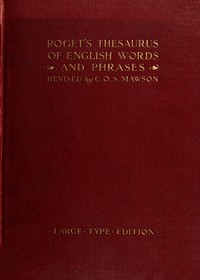
Roget's Thesaurus of English Words and Phrases — Text and Context can be approached with a clearer sense of reading commitment from its source measurements: 477,417 words, 34 hr 36 min estimated reading time, and 220 detected text sections.
The text analysis averages about 4.4 words per sentence, while the detected sections provide another way to judge how the source is divided.
Project Gutenberg metadata also associates the work with “English language -- Synonyms and antonyms,” connecting these edition facts with the source record’s subject description.
Explore this collection
These alternatives are selected using recorded categories and estimated reading time.
About 2,123 minutes
Philology
488,242 recorded words. 47 minutes difference from this book's estimate.
View Gutenberg source #663About 2,228 minutes
Philology
512,336 recorded words. 152 minutes difference from this book's estimate.
View Gutenberg source #660About 2,290 minutes
Philology
526,644 recorded words. 214 minutes difference from this book's estimate.
View Gutenberg source #668Search stored excerpts and compare books → Choose by your preferences →
Choices use stored catalog measurements. Estimates vary with reading speed. A shared category is a catalog label, not a claim that two books have the same argument or literary quality.
Search reads excerpt text stored with this catalog and links to its associated Gutenberg record. The connection is stored in the site database; this tool does not recheck that every excerpt is word-for-word identical to that external record. Excerpt search does not cover every chapter and does not verify historical publication dates.
Catalog snapshot checked: 2026-09-26. Coverage: 93 public books, 93 available source excerpts.
Calculated from edition completeness, EPUB availability, text structure and catalogue metadata. Not a user rating.
Total of 100 points, scaled to a 2.5-5.0 range. Editions with an empty description or a missing EPUB file are not scored.
Public-domain source text
The source text is kept in the dedicated reader, separate from this catalogue record and its commentary.
Roget's Thesaurus is organized not alphabetically but by a system of six primary classes, each subdivided into sections and heads. The opening entries under Class I, Section I, 'Existence,' immediately establish this architecture: head #1 'Existence' lists nouns, verbs, adjectives, and adverbs, then cross-references to related categories like 'Inexistence' (#2). This structure imposes a conceptual order on language, grouping synonyms and antonyms by idea rather than spelling.
The work's backbone is a six-class hierarchy: Abstract Relations, Space, Matter, Intellect, Volition, and Affections. Each class branches into sections and numbered heads. For instance, Class I begins with 'Existence' (#1) and 'Inexistence' (#2), then moves to 'Relation' and 'Quantity.' The numbering system (e.g., #1, #2) allows precise cross-referencing, as seen when #1 directs readers to 'truth &c. 494' and 'coexistence &c. 120.' This structure transforms the thesaurus into a map of conceptual relationships, not merely a list of synonyms.
Cross-references are woven into every entry, often using '&c.' (et cetera) to indicate related categories. Under 'Existence,' the phrase 'truth &c. 494' points to a later head on truth, while 'coexistence &c. 120' links to a head on simultaneity. These references create a network: a reader looking up 'existence' is directed to 'nonexistence,' 'presence,' and 'event.' The system assumes an active user who will follow these threads, making the thesaurus a tool for exploration rather than a static dictionary.
Each head follows a consistent pattern: a Latin or English headword, then lists of nouns (N.), verbs (V.), adjectives (Adj.), adverbs (Adv.), and phrases (Phr.). For example, #1 lists 'existence, being, entity, ens [Lat.], esse [Lat.], subsistence' under nouns, then 'exist, be; have being &c. n.; subsist, live, breathe, stand, obtain' under verbs. This repetition of grammatical categories across heads imposes a uniform structure, allowing readers to quickly locate the part of speech they need. The inclusion of Latin terms like 'ens' and 'esse' adds a scholarly layer, reflecting Roget's background in natural philosophy.
The thesaurus moves fluidly between abstract concepts and concrete examples. Under 'Existence,' abstract nouns like 'reality' and 'actuality' sit alongside phrases like 'stubborn fact' and 'hard fact.' The verb list includes 'vegetate'—a concrete biological term—alongside 'subsist' and 'prevail.' This juxtaposition enriches the user's lexical choices, offering both formal and colloquial options. The closing phrases, such as 'ergo sum cogito [Lat.]' (a playful inversion of Descartes), inject literary and philosophical references, hinting at Roget's wide reading.
Readers approaching this edition should treat the cross-references as invitations to wander. The numbered heads and consistent grammatical layout reward systematic browsing, while the occasional Latin phrase or literary allusion adds texture. Rather than searching for a single word, consider following a chain of references—from 'existence' to 'inexistence' to 'annihilation'—to see how Roget's classification shapes meaning.
I keep thinking about how Roget’s architecture turns words into pathways, each one leading quietly to another. It reminded me of wandering through The Gutenberg Webster's Unabridged Dictionary: Section S — Reading Notes, where definitions feel less like endings and more like doors left ajar. Both linger not for what they say, but for the spaces between entries.
Build a private reading journal entry for this title.