About 2,076 minutes
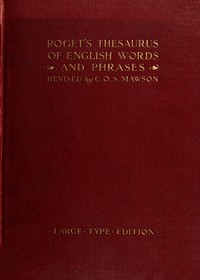
Roget's Thesaurus of English Words and Phrases — Text and Context
Philology
477,417 recorded words. 47 minutes difference from this book's estimate.
View Gutenberg source #10681
The catalog record for The Gutenberg Webster's Unabridged Dictionary: Section F, G and H — Background and Themes provides practical reading context through 488,242 words, 35 hr 23 min estimated reading time, and 64 detected text sections.
The text analysis averages about 10.5 words per sentence, while the detected sections provide another way to judge how the source is divided.
Project Gutenberg metadata also associates the work with “English language -- Dictionaries,” connecting these edition facts with the source record’s subject description.
Explore this collection
These alternatives are selected using recorded categories and estimated reading time.
About 2,076 minutes
Philology
477,417 recorded words. 47 minutes difference from this book's estimate.
View Gutenberg source #10681About 2,228 minutes
Philology
512,336 recorded words. 105 minutes difference from this book's estimate.
View Gutenberg source #660About 2,290 minutes
Philology
526,644 recorded words. 167 minutes difference from this book's estimate.
View Gutenberg source #668Search stored excerpts and compare books → Choose by your preferences →
Choices use stored catalog measurements. Estimates vary with reading speed. A shared category is a catalog label, not a claim that two books have the same argument or literary quality.
Search reads excerpt text stored with this catalog and links to its associated Gutenberg record. The connection is stored in the site database; this tool does not recheck that every excerpt is word-for-word identical to that external record. Excerpt search does not cover every chapter and does not verify historical publication dates.
Catalog snapshot checked: 2026-09-26. Coverage: 93 public books, 93 available source excerpts.
Calculated from edition completeness, EPUB availability, text structure and catalogue metadata. Not a user rating.
Total of 100 points, scaled to a 2.5-5.0 range. Editions with an empty description or a missing EPUB file are not scored.
Public-domain source text
The source text is kept in the dedicated reader, separate from this catalogue record and its commentary.
The first entry under F begins not with a definition but with a detailed account of the letter's history, tracing its form from Egyptian through Phœnician, Greek, and Latin. This immediately signals that the dictionary treats words as historical artifacts, not mere labels. The entry for 'Fabian' illustrates this approach: it defines the term through the Roman general Quintus Fabius Maximus and his cautious tactics, then lists the compound 'Fabian policy' with a full explanation. Such entries show how the dictionary embeds cultural and historical context within definitions.
The opening of the F section establishes etymology as a core concern. The entry for 'F' itself devotes several lines to cognates: 'f is most closely related to p, k, v, and b; as in E. five, Gr. pe`nte; E. wolf, L. lupus, Gr. ly`kos.' This comparative method recurs throughout. For example, 'Fabaceous' is traced to Latin faba (bean), and 'Fabian' to the Roman name Fabius. The dictionary consistently provides the source language and original form, often with references to Greek, Latin, or French. A reader new to this work will quickly learn that each entry is a mini-essay on word origins, not just a definition.
Pronunciation is given thorough treatment. The entry for 'F' includes a note: 'See Guide to Pronunciation, §§ 178, 179, 188, 198, 230.' This cross-reference to the front matter is typical. Within entries, diacritical marks and respellings are used: for 'Fabellae,' the pronunciation is given as 'fă-bĕl′lȧ,' with a macron and breve. The dictionary also notes variant forms, such as 'Glare' as a noun meaning 'a viscous, transparent substance. See Glair.' Such cross-references between entries encourage the reader to follow links, building a network of related terms. The inclusion of obsolete or rare senses, like 'glare' meaning 'glair,' adds depth.
The dictionary covers specialized fields with precision. Under 'G,' entries like 'Glandiferous' (bearing acorns), 'Glandiform' (having the form of a gland), and 'Glandulation' (the situation of secretory vessels in plants) show attention to botanical and anatomical terminology. The entry for 'Glans' lists three distinct senses: anatomical (the apex of the penis), botanical (the acorn), and medical (goiter or pessary). This multi-domain approach means a reader encountering a word in a scientific text can find its exact meaning here. The inclusion of Latin and French etymons, such as 'glandifère' for 'Glandiferous,' further aids those working with older scientific literature.
Definitions are frequently supported by quotations from canonical authors. The entry for 'Fable' cites Addison, Dryden, and Tennyson: 'We grew / The fable of the city where we dwelt.' For 'Glare,' the verb is illustrated with lines from Dryden, Byron, and Pope: 'She glares in balls, front boxes, and the ring.' These quotations do more than confirm usage; they place the word in a literary context, showing how poets and writers have employed it. The dictionary thus serves as a reading companion for English literature. A first-time user can look up a word in a poem and find not only its definition but also examples from other authors, enriching their understanding of the text.
For a first reading, approach this dictionary as a collection of interconnected essays rather than a simple lookup tool. Follow cross-references like 'See Glair' under 'Glare' to see how entries build on each other. Pay attention to the etymological notes and literary quotations, which reveal the historical and cultural layers of the language. The 1913 Webster's is a work of scholarship that rewards browsing as much as targeted searching.
Flipping through the F, G, and H entries feels like revisiting an old friend’s house—the same sturdy furniture of etymology and pronunciation, arranged just so. It made me think back to the earlier rooms in The Gutenberg Webster's Unabridged Dictionary: Section A and B — Inside the Classic, where the same patient cross-references first taught me how to wander. That quiet consistency is oddly comforting.
Capture what you thought, learned, and would like to remember.