About 106 minutes
Hand-book of punctuation — Context and Discussion
Language Study
24,298 recorded words. 7 minutes difference from this book's estimate.
View Gutenberg source #72479
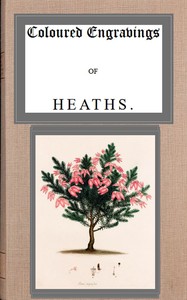
For Coloured engravings of heaths; vol. 4 — A Reader’s Guide, the stored edition analysis reports 25,822 words, 1 hr 53 min estimated reading time, and 7 detected text sections.
The text analysis averages about 13.1 words per sentence, while the detected sections provide another way to judge how the source is divided.
Project Gutenberg metadata also associates the work with “Ericas,” connecting these edition facts with the source record’s subject description.
Explore this collection
These alternatives are selected using recorded categories and estimated reading time.
About 106 minutes
Language Study
24,298 recorded words. 7 minutes difference from this book's estimate.
View Gutenberg source #72479About 123 minutes
Language Study
28,205 recorded words. 10 minutes difference from this book's estimate.
View Gutenberg source #28803About 123 minutes
Language Study
28,102 recorded words. 10 minutes difference from this book's estimate.
View Gutenberg source #39281Search stored excerpts and compare books → Choose by your preferences →
Choices use stored catalog measurements. Estimates vary with reading speed. A shared category is a catalog label, not a claim that two books have the same argument or literary quality.
Search reads excerpt text stored with this catalog and links to its associated Gutenberg record. The connection is stored in the site database; this tool does not recheck that every excerpt is word-for-word identical to that external record. Excerpt search does not cover every chapter and does not verify historical publication dates.
Catalog snapshot checked: 2026-09-26. Coverage: 93 public books, 93 available source excerpts.
Calculated from edition completeness, EPUB availability, text structure and catalogue metadata. Not a user rating.
Total of 100 points, scaled to a 2.5-5.0 range. Editions with an empty description or a missing EPUB file are not scored.
Public-domain source text
The source text is kept in the dedicated reader, separate from this catalogue record and its commentary.
H. C. Andrews's Coloured Engravings of Heaths (vol. 4, 1805) combines precise botanical description with hand-colored illustration. Each entry pairs a Latin specific character and description with an English translation, followed by a reference plate showing dissected parts—often magnified. The work is organized by a systematic arrangement and an alphabetical index, reflecting the Linnaean classification Andrews followed.
Andrews's prose is notably candid. In the entry for Erica præstans, he admits the plant 'does not possess any prominent feature sufficient to distinguish it from many others,' and that its specific title is an 'appellation to which the plant has but little claim.' Such frankness, unusual in botanical writing of the period, gives the volume a distinctive voice.
Andrews's English descriptions rely on a consistent, technical vocabulary. He uses terms like 'awl-shaped,' 'incurved,' 'turban-shaped,' and 'villose' to capture minute details. The descriptions are formulaic: stem height and habit, leaf arrangement and shape, flower position and color, and seed-bud structure. This regularity allows readers to compare species quickly. For Erica Andromedæflora, alba, he notes the 'blossom ovate, thick, and white' and the 'seed-bud turban-shaped, villose.' The repetition of 'turban-shaped' across multiple entries suggests a deliberate choice to describe the distinctive form of the ovary. Andrews also includes practical observations: the white-flowered variety is 'hardy, dwarf, and robust,' with flowers 'of a thickish and rather tough consistence.' Such remarks bridge scientific description and horticultural advice.
Andrews's authorial voice emerges most clearly in his evaluative comments. He does not hesitate to question taxonomic decisions. Of Erica præstans, he writes that the plant 'does not possess any prominent feature sufficient to distinguish it from many others' and that the name præstans is 'an appellation to which the plant has but little claim.' This critical stance is tempered by his acknowledgment of the genus's diversity: 'the numerous beautiful species of which this very extensive Genus is composed.' In the entry for Erica Andromedæflora, alba, he considers whether the white-flowered variety might be a distinct species, but concludes that 'the appearance and shape of the blossoms bear out the specific title too well to admit of any alteration.' These passages reveal a botanist engaged in active taxonomic reasoning, not merely recording facts.
Each entry follows a rigid structure: specific character (in Latin and English), description, habitat, flowering time, and a reference key to the accompanying plate. The plates include magnified dissections of the 'chives and pointal' (stamens and pistil), the seed-bud, and the empalement (calyx). For Erica pumila, the reference lists a leaf, the empalement magnified, a chive magnified, and the seed-bud with summit magnified. This systematic approach ensures that the illustrations serve as verifiable evidence for the specific distinctions Andrews describes. The magnifications are crucial: they allow readers to see the 'crested tips' (antheræ cristatæ) or the 'beardless tips' (antheris imberbibus) that define species groups. The structure thus mirrors the Linnaean method, making the volume a practical tool for identification.
All species in this volume are 'Native of the Cape of Good Hope,' reflecting the early 19th-century influx of South African plants into European gardens. Andrews records flowering times in England: Erica Andromedæflora, alba flowers 'from March till June,' while Erica argentiflora blooms 'from June till November.' He notes cultivation details: the white-flowered variety is a 'hardy green-house shrub,' and Erica pumila was 'first raised at the Hibbertian collection in 1805, by Mr. Knight, with whom it has flowered this summer, for the first time in England.' These remarks place the work within a network of collectors and gardeners. Andrews also comments on growth habits: Erica pumila is 'a dwarf shrub, the large and small branches numerous, straddling,' and its figure shows 'the entire plant, just as we received it growing in a pot.' Such details ground the botanical descriptions in lived horticultural practice.
Andrews's volume rewards readers who attend to both the systematic descriptions and the candid asides. The interplay between Latin diagnosis and English commentary reveals a botanist navigating the tensions of classification. The engravings and dissections are not merely decorative but integral to the argument. For those interested in the history of botanical illustration or the cultivation of Cape heaths, this work offers a primary source that is at once scientific and personal.
I have spent evenings with Coloured Engravings of Heaths, its patient records of growth and classification, and found a quiet kinship with this Spalding's Official Baseball Guide - 1913 — Themes and Context. Both are ledgers of longing—one for floral perfection, the other for a season's clean innings. Each year, someone's careful hand counted what mattered, and the pages still hold that tender arithmetic.
Your answers remain private and are stored only in this browser.