About 99 minutes
The Internet and Languages [around the year 2000] — Background and Themes
Language Study
22,580 recorded words. 7 minutes difference from this book's estimate.
View Gutenberg source #30422
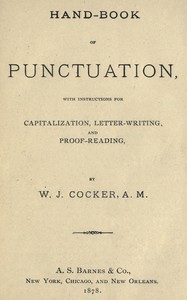
The catalog record for Hand-book of punctuation — Context and Discussion provides practical reading context through 24,298 words, 1 hr 46 min estimated reading time, and 9 detected text sections.
The text analysis averages about 15.2 words per sentence, while the detected sections provide another way to judge how the source is divided.
Project Gutenberg metadata also associates the work with “English language -- Punctuation,” connecting these edition facts with the source record’s subject description.
Explore this collection
These alternatives are selected using recorded categories and estimated reading time.
About 99 minutes
Language Study
22,580 recorded words. 7 minutes difference from this book's estimate.
View Gutenberg source #30422About 113 minutes
Language Study
25,822 recorded words. 7 minutes difference from this book's estimate.
View Gutenberg source #70072About 97 minutes
Language Study
22,247 recorded words. 9 minutes difference from this book's estimate.
View Gutenberg source #63292Search stored excerpts and compare books → Choose by your preferences →
Choices use stored catalog measurements. Estimates vary with reading speed. A shared category is a catalog label, not a claim that two books have the same argument or literary quality.
Search reads excerpt text stored with this catalog and links to its associated Gutenberg record. The connection is stored in the site database; this tool does not recheck that every excerpt is word-for-word identical to that external record. Excerpt search does not cover every chapter and does not verify historical publication dates.
Catalog snapshot checked: 2026-09-26. Coverage: 93 public books, 93 available source excerpts.
Calculated from edition completeness, EPUB availability, text structure and catalogue metadata. Not a user rating.
Total of 100 points, scaled to a 2.5-5.0 range. Editions with an empty description or a missing EPUB file are not scored.
Public-domain source text
The source text is kept in the dedicated reader, separate from this catalogue record and its commentary.
William Johnson Cocker's Hand-book of Punctuation (1878) opens with a striking analogy: just as pronunciation follows the usage of the best speakers, punctuation should be based on the usage of the best writers. This premise drives the entire manual, which aims to state general rules, illustrate them with examples from English classics, and note differences in usage among good writers. Cocker addresses a practical problem—the neglect of punctuation in schools and business—and warns that careless punctuation has led to expensive lawsuits. His tone is authoritative yet pragmatic, positioning the handbook as a remedy for widespread ignorance.
Cocker distinguishes three categories of punctuation rules: invariable ones, those dependent on the writer's mental characteristics, and those governed by taste alone. This taxonomy reveals his awareness that punctuation is not purely mechanical. He insists that even when good writers differ, there are underlying principles. For instance, he notes that a writer's mode of expressing thoughts determines the character and number of marks used—a claim that ties punctuation directly to style and meaning. The preface frames the handbook as a response to the inadequacy of existing composition textbooks, which he says lack clear rules and sufficient examples.
Cocker's rules for capitals go beyond simple sentence starts. He mandates capitals for pronouns referring to the Deity when standing alone, citing Whittier's line "O Thou! with whom the night is day" as an example. Yet he warns against "ridiculous excess" in poetry. He also distinguishes between the Christian God (capitalized) and heathen divinities (lowercase). Quotations receive careful treatment: a full-sentence quote begins with a capital, but after that it does not. Single-word quotations like "Victory" are capitalized. These fine-grained rules show Cocker's concern for semantic precision through typography.
Cocker devotes rules to words used in a special sense—such as "the Reformation" or "the Middle Ages"—which require capitals. He acknowledges that other words may be capitalized according to the writer's judgment, but cautions that overuse lessens force and disfigures the page. Personification also earns a rule: things without life, when represented as persons, may begin with capitals. His example, "Father Time," illustrates the principle. These sections reveal Cocker's balancing act between prescription and flexibility, as he recognizes that some choices must be left to taste.
The handbook extends beyond punctuation to letter-writing and proofreading. Cocker criticizes business men who claim no time to punctuate, forcing others to decipher meaning. He cites serious misunderstandings and lawsuits from omitted or incorrect marks. The proofreading section likely addresses common errors and correction symbols. Although the excerpts do not detail these sections, the preface's emphasis on practical utility suggests a methodical approach. Cocker's inclusion of these topics underscores his belief that punctuation is not an academic nicety but a necessary skill for clear communication in commerce and law.
Cocker's handbook is best read as a period artifact that reveals late-19th-century attitudes toward language standardization. His reliance on examples from English classics—and his willingness to note variations among good writers—offers a window into the evolving norms of written English. Readers interested in historical grammar or the rhetoric of correctness will find this manual a valuable primary source, provided they treat its prescriptions as descriptive of one author's ideal rather than universal law.
Old Cocker's rules made me think of how deeply we trust someone else's careful ordering, almost like a private conversation across years. I kept remembering that other collection, the quiet way it gathers scattered knowledge into something touchable. It lingered the same way: How to Use the Popular Science Library; History of Science; General Index — Reading Notes feels like someone patiently holding a lantern for you without ever saying look.
Your answers remain private and are stored only in this browser.