About 99 minutes
The Internet and Languages [around the year 2000] — Background and Themes
Language Study
22,580 recorded words. 2 minutes difference from this book's estimate.
View Gutenberg source #30422
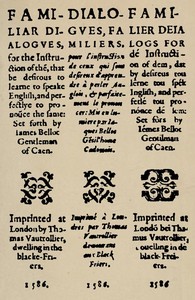
This digital edition of Familiar dialogues — Reading Companion is described by source-level measurements including 22,247 words, 1 hr 37 min estimated reading time, and 9 detected text sections.
The text analysis averages about 11.5 words per sentence, while the detected sections provide another way to judge how the source is divided.
Project Gutenberg metadata also associates the work with “English language -- Conversation and phrase books -- French -- Early works to 1800,” connecting these edition facts with the source record’s subject description.
Explore this collection
These alternatives are selected using recorded categories and estimated reading time.
About 99 minutes
Language Study
22,580 recorded words. 2 minutes difference from this book's estimate.
View Gutenberg source #30422About 106 minutes
Language Study
24,298 recorded words. 9 minutes difference from this book's estimate.
View Gutenberg source #72479About 87 minutes
Language Study
19,805 recorded words. 10 minutes difference from this book's estimate.
View Gutenberg source #58572Search stored excerpts and compare books → Choose by your preferences →
Choices use stored catalog measurements. Estimates vary with reading speed. A shared category is a catalog label, not a claim that two books have the same argument or literary quality.
Search reads excerpt text stored with this catalog and links to its associated Gutenberg record. The connection is stored in the site database; this tool does not recheck that every excerpt is word-for-word identical to that external record. Excerpt search does not cover every chapter and does not verify historical publication dates.
Catalog snapshot checked: 2026-09-26. Coverage: 93 public books, 93 available source excerpts.
Calculated from edition completeness, EPUB availability, text structure and catalogue metadata. Not a user rating.
Total of 100 points, scaled to a 2.5-5.0 range. Editions with an empty description or a missing EPUB file are not scored.
Public-domain source text
The source text is kept in the dedicated reader, separate from this catalogue record and its commentary.
Jacques Bellot's Familiar Dialogues (1586) is a language-learning manual designed for French Protestant refugees who had fled to England. The book presents side-by-side columns of French, standard English, and a phonetic respelling of English—a rare window into Elizabethan pronunciation. Bellot's dedication to Mark de Bussy explains his motivation: he had experienced the sorrow of being unable to understand or be understood in a foreign country. The dialogues cover practical situations such as greeting neighbors, shopping for food, and enrolling a child in school, giving modern readers a glimpse of daily concerns in the 1580s.
Bellot's most distinctive feature is his phonetic transcription of English, placed in a third column alongside French and standard English. For example, "Good morow neighbour" becomes "Goud màro nèèbeur," and "I thanke you Syr" is rendered "Ey tànk y Ser." This system reveals how English was spoken by French learners and possibly by native speakers. The transcription is not systematic by modern standards—Bellot uses French orthographic conventions, such as ou for /uː/ in "goud" and è for /eɪ/ in "nèèbeur." Nonetheless, it provides valuable evidence for vowel sounds, consonant clusters, and stress patterns. The inclusion of this column shows Bellot's practical focus: he wanted refugees to pronounce English correctly, not just read it.
The dialogues center on domestic and commercial interactions. In one exchange, a schoolmaster asks why his gossip's wife has not come, and the neighbor lists her errands: buying eggs, a pig, nuts, peas, beans, oatmeal, puddings, sausages, apples, pears, cherries, raisins, figs, butter, rice, milk, plums, prunes, almonds, turnips, a pie, a cake, a custard, oranges, lemons, a cabbage, and a hen. This inventory reflects the diet of a prosperous household. The conversation also reveals social hierarchies: the schoolmaster addresses a woman as "mistresse" and a man as "Syr," while the neighbor uses "gossip" as a familiar term. The schoolmaster's wife is described as "very busie at home," reinforcing gendered domestic roles.
Bellot's dedication explicitly addresses the plight of French Protestants exiled after religious persecutions. He writes that he was "moued to compassion" for those who "can not vnderstand the language of that place in whiche they be exiled." The dialogues are thus survival tools: they teach how to greet, shop, and place a child in school. One exchange mentions "the sickenesse and the dearth, which be now a dayes almost throughout all Fraunce," grounding the text in contemporary hardship. The book's trilingual format—French, English, and phonetic English—reflects a pedagogical strategy that prioritizes oral communication. Bellot's work is not a literary text but a practical response to a historical crisis, offering modern readers a direct link to the experiences of 16th-century migrants.
Readers should approach Familiar Dialogues as a historical artifact rather than a narrative. The phonetic column rewards close attention: comparing the standard and phonetic versions reveals how English sounded to French ears. The dialogues are short and repetitive, reflecting their instructional purpose. For those interested in historical linguistics, the book is a primary source for Elizabethan pronunciation; for social historians, it documents the material culture and social etiquette of the period. Bellot's work is best read slowly, with an eye on the interplay between the three columns.
There's something tender about hearing voices from 1586 — strangers figuring out each other’s tongues, their accents caught mid-air. Bellot’s little book feels like that: a hand held out across centuries. It makes me think of all the quiet tools we leave behind for later readers, like that old index to the science library, a patient map of curiosity. How to Use the Popular Science Library; History of Science; General Index — Reading Notes has that same modest, slightly worn quality, a shelf-friend waiting for someone to sit down beside it.
Your answers remain private and are stored only in this browser.