About 354 minutes
English grammar — Key Ideas to Explore
Grammar
81,191 recorded words. 15 minutes difference from this book's estimate.
View Gutenberg source #76768
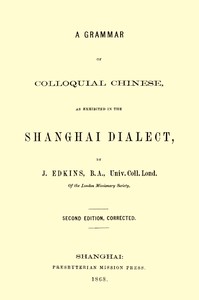
The catalog record for A Grammar of Colloquial Chinese, as Exhibited in the Shanghai Dialect — Story, Setting & Ideas provides practical reading context through 77,956 words, 5 hr 39 min estimated reading time, and 12 detected text sections.
The text analysis averages about 13.4 words per sentence, while the detected sections provide another way to judge how the source is divided.
Project Gutenberg metadata also associates the work with “Chinese language -- Grammar,” connecting these edition facts with the source record’s subject description.
Explore this collection
These alternatives are selected using recorded categories and estimated reading time.
About 354 minutes
Grammar
81,191 recorded words. 15 minutes difference from this book's estimate.
View Gutenberg source #76768About 361 minutes
Grammar
82,822 recorded words. 22 minutes difference from this book's estimate.
View Gutenberg source #59795About 296 minutes
Grammar
67,955 recorded words. 43 minutes difference from this book's estimate.
View Gutenberg source #50595Search stored excerpts and compare books → Choose by your preferences →
Choices use stored catalog measurements. Estimates vary with reading speed. A shared category is a catalog label, not a claim that two books have the same argument or literary quality.
Search reads excerpt text stored with this catalog and links to its associated Gutenberg record. The connection is stored in the site database; this tool does not recheck that every excerpt is word-for-word identical to that external record. Excerpt search does not cover every chapter and does not verify historical publication dates.
Catalog snapshot checked: 2026-09-26. Coverage: 93 public books, 93 available source excerpts.
Calculated from edition completeness, EPUB availability, text structure and catalogue metadata. Not a user rating.
Total of 100 points, scaled to a 2.5-5.0 range. Editions with an empty description or a missing EPUB file are not scored.
Public-domain source text
The source text is kept in the dedicated reader, separate from this catalogue record and its commentary.
Joseph Edkins opens his 1868 grammar by positioning it within a lineage of Chinese grammatical study, citing Prémare, Remusat, and Bazin. He narrows his focus to the Shanghai dialect, a choice he justifies on missionary and commercial grounds, noting that no prior work had addressed the speech of Kiáng-nán. Edkins proposes a new tone nomenclature based on what he calls the “real character” of tones, distinguishing his system from the arbitrary names used elsewhere. He identifies over twenty natural tones from which dialects select sets of four to eight.
Edkins devotes considerable attention to the sound system, adopting Sir W. Jones’s alphabetic system as modified by J. R. Morrison. He argues that existing tone names, though precise for their author’s dialect, are not transferable. His own nomenclature aims to describe tones by their actual phonetic character. The grammar thus treats sound as the primary locus of dialectal variation, while claiming that idioms differ little from Mandarin. This focus on phonetics reflects Edkins’s broader philological method: he collects facts overlooked by wider-scope writers.
Edkins catalogues verbs formed by apposition of a transitive verb and an adjective, such as ká dzáng (add long, to lengthen) and tsú’ ’hau (do good, complete making). He observes that Chinese compensates for the lack of derivational endings by prefixing separate words, analogous to English phrases like “rub smooth.” He also lists enclitics—words like sah (to kill) and dzû‘ (resist)—that attach to verbs to modify meaning. For example, ’tsú dzû‘ means “resist,” and ’ngau dzû‘ means “hold with the teeth.” These examples illustrate how the grammar dissects colloquial usage into systematic patterns.
Edkins notes that in many cases a substantive follows a verb where it would be unnecessary in English, as in ’tseu lú‘ (walk road) and tsuh pú‘ (weave cloth). He attributes this to the “rhythmical construction of sentences, peculiar and essential to the Chinese language.” The grammar also points out that when a substantive is governed by another verb, its usual companion may be appended redundantly, as in dzing van‘ k’iuh (seek food eat), where “eat” is superfluous. These observations reveal Edkins’s attention to the spoken language’s structural demands.
Edkins identifies dissyllabic transitive verbs where one constituent is a substantive, such as wé deu (turn head, to answer) and lóng‘ zun (trick spirits, to deceive). He provides example sentences: “veh ’hau lóng‘ zun báng ’yeu” (you should not deceive friends) and “dzieu lé wé deu ’ngú” (come at once and tell me). These examples demonstrate how the grammar moves from classification to usage, grounding its analysis in colloquial speech. Edkins’s method is taxonomic, but his examples keep the reader anchored in actual spoken phrases.
Edkins’s grammar is best read as a specimen of nineteenth-century missionary philology, where linguistic description served practical ends. Readers interested in the history of Chinese dialect studies will find his tone nomenclature and verb classifications valuable, even if his framework now appears dated. The work rewards attention to its examples, which preserve the sound and structure of mid-nineteenth-century Shanghai colloquial.
I sometimes find myself turning pages of Edkins’s old Shanghai grammar, noting how tones and verbs settle into their own quiet rhythms. It reminds me of another patient companion, the one that maps our own English sentences with equal care. Both ask, gently, that we listen before we speak. English grammar — Key Ideas to Explore holds that same unhurried hand.
Build a private reading journal entry for this title.