About 265 minutes
Elements of Gaelic Grammar — Story, Setting & Ideas
Grammar
60,833 recorded words. 31 minutes difference from this book's estimate.
View Gutenberg source #28766
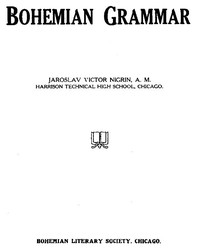
The source record for Bohemian Grammar — Context and Discussion measures this digital text at 67,955 words, 4 hr 56 min estimated reading time, and 10 detected text sections.
The text analysis averages about 11.1 words per sentence, while the detected sections provide another way to judge how the source is divided.
Project Gutenberg metadata also associates the work with “Czech language -- Grammar,” connecting these edition facts with the source record’s subject description.
Explore this collection
These alternatives are selected using recorded categories and estimated reading time.
About 265 minutes
Grammar
60,833 recorded words. 31 minutes difference from this book's estimate.
View Gutenberg source #28766About 260 minutes
Grammar
59,617 recorded words. 36 minutes difference from this book's estimate.
View Gutenberg source #25604About 339 minutes
Grammar
77,956 recorded words. 43 minutes difference from this book's estimate.
View Gutenberg source #62128Search stored excerpts and compare books → Choose by your preferences →
Choices use stored catalog measurements. Estimates vary with reading speed. A shared category is a catalog label, not a claim that two books have the same argument or literary quality.
Search reads excerpt text stored with this catalog and links to its associated Gutenberg record. The connection is stored in the site database; this tool does not recheck that every excerpt is word-for-word identical to that external record. Excerpt search does not cover every chapter and does not verify historical publication dates.
Catalog snapshot checked: 2026-09-26. Coverage: 93 public books, 93 available source excerpts.
Calculated from edition completeness, EPUB availability, text structure and catalogue metadata. Not a user rating.
Total of 100 points, scaled to a 2.5-5.0 range. Editions with an empty description or a missing EPUB file are not scored.
Public-domain source text
The source text is kept in the dedicated reader, separate from this catalogue record and its commentary.
Jaroslav Victor Nigrin opens his 1918 Bohemian Grammar with a clear pedagogical aim: to present the Czech language “along modern lines” for English-speaking students. He explicitly adapts the standard work of Dr. Jan Gebauer, but reshapes it for practical use in American classrooms and private study. The preface stresses pronunciation from the outset, urging students to “learn the language by ear and eye” and to practice oral exercises “by the entire class in unity.” This emphasis on spoken language, supported by numerous Czech exercises and readings, sets the tone for a grammar that is as much about active use as about rules.
Nigrin’s preface outlines a deliberate strategy: “Repetition makes mastery,” he writes, and he does not hesitate to revisit difficult points. The exercises reflect this—early drills on cases give way to short articles, fables, and poems, which he believes teach “correct Bohemian” more effectively than translation from English. The book includes more Czech-to-English exercises than the reverse, a choice that prioritizes comprehension over production. This structure suggests a confidence in immersion: the student is expected to absorb patterns through repeated exposure to authentic language, not just through memorized paradigms.
The narrative voice in the grammar is direct and teacherly, often using imperatives (“Learn,” “Do not hesitate”) and first-person plural (“we tried to simplify”). The pace varies: dense explanations of declensions or passive voice syntax are punctuated by brisk exercise lists and proverbs. For instance, after a technical passage on the instrumental case, the reader encounters a string of pithy sayings like “Hlad nedá se slovem utišiti” (Hunger cannot be quieted with words). These shifts from formal rule to folk wisdom keep the text from becoming monotonous and mirror Nigrin’s belief that language lives in use, not just in tables.
Throughout the exercises, Nigrin weaves in Czech proverbs and everyday expressions, such as “Ne každému štěstí slouží” (Fortune does not serve everyone) and “Bláznu i dřevěný peníz dobrý” (A wooden penny is good enough for a fool). These are not merely filler; they serve as compact examples of case usage and syntax while offering a glimpse into Czech folk wisdom. The grammar also includes a dedication to Charles R. Crane, “a true and enlightened friend of the Slavs,” situating the work within early 20th-century American interest in Slavic cultures. This cultural embedding, though subtle, enriches the otherwise technical material.
Nigrin’s grammar is best approached as a workbook: read the explanations aloud, complete the oral exercises in groups, and return to difficult sections as recommended. The proverbs and short texts reward repeated reading, and the emphasis on ear-training means that listening to a native speaker—or reading aloud—will amplify the book’s effectiveness. The preface’s advice to “learn by ear and eye” remains the most practical guide to using this text.
There’s something tender about Nigrin’s insistence on hearing Bohemian before seeing it, trusting the ear to carry what translation can’t. It reminds me of another old grammar, this one for Shanghai dialect—both books feel like doorways left ajar for someone patient enough to listen. A Grammar of Colloquial Chinese, as Exhibited in the Shanghai Dialect — Story, Setting & Ideas holds that same quiet faith in spoken breath.
Save your reaction, strongest insight, and memorable passage.