About 226 minutes
Lessons in the Shanghai Dialect — Themes and Context
Grammar
51,849 recorded words. 10 minutes difference from this book's estimate.
View Gutenberg source #62130
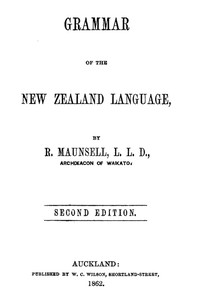
Grammar of the New Zealand language (2nd edition) — Inside the Classic can be approached with a clearer sense of reading commitment from its source measurements: 54,220 words, 3 hr 56 min estimated reading time, and 9 detected text sections.
The text analysis averages about 14.8 words per sentence, while the detected sections provide another way to judge how the source is divided.
Project Gutenberg metadata also associates the work with “Māori language -- Grammar,” connecting these edition facts with the source record’s subject description.
Explore this collection
These alternatives are selected using recorded categories and estimated reading time.
About 226 minutes
Grammar
51,849 recorded words. 10 minutes difference from this book's estimate.
View Gutenberg source #62130About 223 minutes
Grammar
51,235 recorded words. 13 minutes difference from this book's estimate.
View Gutenberg source #49692About 260 minutes
Grammar
59,617 recorded words. 24 minutes difference from this book's estimate.
View Gutenberg source #25604Search stored excerpts and compare books → Choose by your preferences →
Choices use stored catalog measurements. Estimates vary with reading speed. A shared category is a catalog label, not a claim that two books have the same argument or literary quality.
Search reads excerpt text stored with this catalog and links to its associated Gutenberg record. The connection is stored in the site database; this tool does not recheck that every excerpt is word-for-word identical to that external record. Excerpt search does not cover every chapter and does not verify historical publication dates.
Catalog snapshot checked: 2026-09-26. Coverage: 93 public books, 93 available source excerpts.
Calculated from edition completeness, EPUB availability, text structure and catalogue metadata. Not a user rating.
Total of 100 points, scaled to a 2.5-5.0 range. Editions with an empty description or a missing EPUB file are not scored.
Public-domain source text
The source text is kept in the dedicated reader, separate from this catalogue record and its commentary.
Robert Maunsell's Grammar of the New Zealand Language, second edition (1862), is structured as a pedagogical reference, not a descriptive survey. The preface announces the omission of "extreme niceties" to aid the beginner, a decision that shapes the book's layout. Maunsell organizes material by parts of speech and syntax, but within each section he frequently inserts dialectal observations—often in smaller type—that reveal his fieldwork across the northern island. The work thus moves between general rules and local exceptions, a pattern that rewards careful reading.
Maunsell's text is punctuated by remarks on regional variation. In the preface to the first edition he lists seven leading dialects, from the Rarawa north of Kaitaia to the speech of Port Nicholson and Wanganui. These distinctions reappear in the body: for instance, the particle ai is noted as being used more broadly at Taupo and the East Cape, while the Waikato usage is given as the standard. Similarly, ano is said to admit wider application among Ngapuhi speakers. These asides do not merely annotate; they create a layered structure where the main exposition is continually qualified by geographic notes. The reader encounters not a monolithic "Maori" but a set of related practices.
A substantial portion of the grammar is devoted to particles such as ai, ano, ra, and koa. Maunsell treats each with multiple glosses and example sentences. For ai, he distinguishes its use as a relative marker, a sequential connective, and occasionally a "simple expletive." The examples—Haere, ka hoki mai ai ("go, and then return")—show how the particle governs clause linkage. The author also warns foreigners against erroneous omission or insertion, a recurring pedagogical move. This focus on particles gives the grammar a distinctive rhythm: short, dense entries followed by illustrative phrases, often drawn from natural speech or narrative.
Maunsell frequently interrupts his own rules with notes that complicate them. For ano, he lists seven distinct meanings—"indeed," "also," "only," "immediately," "same," "different," "again"—each with a Maori phrase. The entry on ra similarly shifts from relative pronoun to locative adverb to imperative particle. This method reflects the author's awareness that a single form can serve multiple functions. The typography reinforces the structure: smaller type for "remarks of less importance to a beginner" creates a visual hierarchy. The effect is a text that teaches by accumulation and contrast, not by simple definition.
The preface to the second edition states that Maunsell omitted "many passages exhibiting extreme niceties" that were "complained of as embarrassing to the beginner." This revision strategy is visible in the surviving text: the particle entries are concise, yet still retain dialect notes. The author also acknowledges the help of Mr. Fenton, who saw the work through the press. The first edition's longer preface, reprinted here, gives a fuller dialect survey. Comparing the two prefaces reveals a shift in audience—from the "finished scholar" to the "ordinary student." The grammar thus carries traces of its own editorial history, a feature that invites the reader to consider how pedagogical texts are shaped by user feedback.
This edition rewards a non-linear approach. Readers may start with the particle entries, then cross-reference the dialect notes, or read the prefaces last to see how the author framed his project. The grammar is best treated as a working document: its inconsistencies—such as those between the table of contents and the text—are part of its character. Maunsell's voice is that of a field linguist and teacher, and his book remains a valuable record of 19th-century Maori as heard in specific regions.
Reading about Maunsell revising his grammar for learners brought back evenings with my grandmother’s old language notes, her pencil marks in the margins. That patient, second-edition care reminded me of something similar in Bohemian Grammar — Context and Discussion. Both felt less like textbooks, more like someone leaving a lamp on for the next traveler.
Capture what you thought, learned, and would like to remember.