About 354 minutes
English grammar — Key Ideas to Explore
Grammar
81,191 recorded words. 7 minutes difference from this book's estimate.
View Gutenberg source #76768
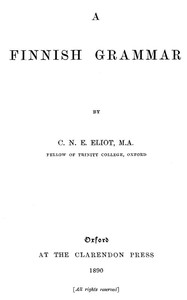
The source record for A Finnish Grammar — Themes and Context measures this digital text at 82,822 words, 6 hr 1 min estimated reading time, and 19 detected text sections.
The text analysis averages about 11.9 words per sentence, while the detected sections provide another way to judge how the source is divided.
Project Gutenberg metadata also associates the work with “Finnish language -- Grammar,” connecting these edition facts with the source record’s subject description.
Explore this collection
These alternatives are selected using recorded categories and estimated reading time.
About 354 minutes
Grammar
81,191 recorded words. 7 minutes difference from this book's estimate.
View Gutenberg source #76768About 339 minutes
Grammar
77,956 recorded words. 22 minutes difference from this book's estimate.
View Gutenberg source #62128About 397 minutes
Grammar
91,254 recorded words. 36 minutes difference from this book's estimate.
View Gutenberg source #45738Search stored excerpts and compare books → Choose by your preferences →
Choices use stored catalog measurements. Estimates vary with reading speed. A shared category is a catalog label, not a claim that two books have the same argument or literary quality.
Search reads excerpt text stored with this catalog and links to its associated Gutenberg record. The connection is stored in the site database; this tool does not recheck that every excerpt is word-for-word identical to that external record. Excerpt search does not cover every chapter and does not verify historical publication dates.
Catalog snapshot checked: 2026-09-26. Coverage: 93 public books, 93 available source excerpts.
Calculated from edition completeness, EPUB availability, text structure and catalogue metadata. Not a user rating.
Total of 100 points, scaled to a 2.5-5.0 range. Editions with an empty description or a missing EPUB file are not scored.
Public-domain source text
The source text is kept in the dedicated reader, separate from this catalogue record and its commentary.
Eliot’s 1890 grammar, the first of its kind in English, opens with a frank admission: Finnish was then “in so unsettled and fluid a condition” that even native speakers disagreed on correctness. Rather than prescribe, Eliot set out to record forms and constructions actually found in print, drawing examples chiefly from the Kalevala, the Bible, and Ahlqvist’s proverb collection. The result is a descriptive snapshot of late-nineteenth-century literary Finnish, shaped by the author’s collaboration with his Finnish-speaking assistant, Mr. Putro, and by his reliance on the grammars of Genetz, Hämäläinen, Jahnsson, and Setälä.
Eliot’s method is to illustrate each rule with multiple citations, often keyed to specific lines from the Kalevala (e.g., “Itki illat, itki aamut, yöhyet ennemmin itki, Kal. v. 7, 8”). He also draws on the Bible, modern novels, and the dictionaries of Lönnrot and Geitlin. Where no published source exists, he states that the example “has been approved by natives.” This reliance on attested usage gives the grammar a documentary quality: it reports what was written, not what ought to be written. The reader is thus invited to treat the examples as primary data, not merely as illustrations of a pre-existing rule.
Eliot devotes considerable space to the partitive case, which Finnish uses in ways unfamiliar to an English speaker. Beyond its core function of indicating partial objects, the partitive appears in salutations (“Hyvää iltaa”), exclamations (“kauheaa!”), and even in expressions like “voi päiviäni.” Eliot explains these as arising from “the omission of some word,” implying a grammatical ellipsis. This observation reveals how the partitive can carry emotional or conventional weight, not just syntactic information. The grammar’s treatment of such idiomatic uses is one of its strengths, showing a linguist’s sensitivity to pragmatics.
Eliot distinguishes three main genitive functions: subjective (“Alqwistin teokset”), objective (“jumalan pelko”), and determinative (“Helsingin kaupunki”). He also notes a less obvious use: the genitive with adjectives of age, measure, or character, as in “sormen pituinen” (of a finger’s length) or “venäläisen luontoinen” (Russian in character). More strikingly, the genitive appears with impersonal verbs of necessity (“Minun pitää lähteä”) and with expressions of physical state (“Minun on jano”). Eliot tentatively suggests that this may reflect an old dative in -n that merged with the genitive, a philological hypothesis that adds depth to the descriptive account.
Eliot’s treatment of the accusative hinges on the notion of “total” action: the direct object is accusative when the verb’s action is regarded as complete, as in “Isä ostaa kirjan pojalle.” He also documents the accusative of duration (“Viivyn päivän”) and of frequency (“ensimäisen kerran”). A curious detail is that expressions with “joka” (every) remain in the nominative, even when they function adverbially (“Olen joka kerta matkustanut meritse”). Such fine-grained observations, drawn from multiple sources, make the grammar a valuable record of how 19th-century literary Finnish handled aspect and quantification.
Eliot’s grammar is best read as a period document: it captures a language in transition, with the author acting as a careful observer rather than a legislator. Readers interested in historical linguistics will appreciate the references to dialectal variation (e.g., the St. Petersburg use of “minulla” for “minun” in expressions of thirst) and the occasional comparative note. For learners, the dense array of examples—many from the Kalevala—offers a direct encounter with the literary language of the time, though the absence of exercises or progressive lessons means it serves better as a reference than a tutorial.
Holding Eliot’s grammar, I kept thinking how strange it is to learn a language through proverbs and Kalevala lines, as if every verb carried an echo of old singing. That same quiet feeling returned last week with a A short introduction to English grammar — Themes and Context—my own language, suddenly unfamiliar, and I was a beginner again, grateful for the patience such books ask of us.
Save your reaction, strongest insight, and memorable passage.