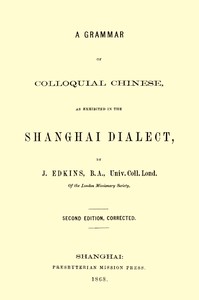
About 226 minutes
Lessons in the Shanghai Dialect — Themes and Context
Grammar
51,849 recorded words. 3 minutes difference from this book's estimate.
View Gutenberg source #62130
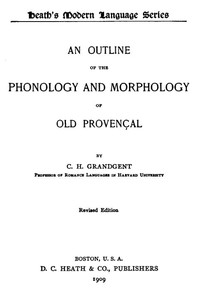
An Outline of the Phonology and Morphology of Old Provençal — Themes and Context can be approached with a clearer sense of reading commitment from its source measurements: 51,235 words, 3 hr 43 min estimated reading time, and 11 detected text sections.
The text analysis averages about 14.2 words per sentence, while the detected sections provide another way to judge how the source is divided.
Project Gutenberg metadata also associates the work with “Provençal language -- Grammar,” connecting these edition facts with the source record’s subject description.
Explore this collection
These alternatives are selected using recorded categories and estimated reading time.
About 226 minutes
Grammar
51,849 recorded words. 3 minutes difference from this book's estimate.
View Gutenberg source #62130About 236 minutes
Grammar
54,220 recorded words. 13 minutes difference from this book's estimate.
View Gutenberg source #44897About 260 minutes
Grammar
59,617 recorded words. 37 minutes difference from this book's estimate.
View Gutenberg source #25604Search stored excerpts and compare books → Choose by your preferences →
Choices use stored catalog measurements. Estimates vary with reading speed. A shared category is a catalog label, not a claim that two books have the same argument or literary quality.
Search reads excerpt text stored with this catalog and links to its associated Gutenberg record. The connection is stored in the site database; this tool does not recheck that every excerpt is word-for-word identical to that external record. Excerpt search does not cover every chapter and does not verify historical publication dates.
Catalog snapshot checked: 2026-09-26. Coverage: 93 public books, 93 available source excerpts.
Calculated from edition completeness, EPUB availability, text structure and catalogue metadata. Not a user rating.
Total of 100 points, scaled to a 2.5-5.0 range. Editions with an empty description or a missing EPUB file are not scored.
Public-domain source text
The source text is kept in the dedicated reader, separate from this catalogue record and its commentary.
Grandgent's preface immediately establishes the book's scope: it is a guide for students of Romance Philology, not a comprehensive dialect survey. He explicitly limits his work to the old literary language, noting that modern forms would be 'too bewildering.' This decision shapes every subsequent section, as the reader encounters a deliberate narrowing of evidence to the troubadour-era standard.
The preface, dated 1905, reveals Grandgent's twenty-year accumulation of material, beginning with a course by Paul Meyer in 1884–85. He cites major sources—Diez, Meyer-Lübke, Suchier, Crescini, Appel—and acknowledges his reliance on Mistral's dictionary for modern dialect data. Crucially, he states that his knowledge and material are 'not adequate to a satisfactory presentation of the living idioms.' This honest limitation tells the reader that the outline is a synthesis of earlier scholarship, not a field study. The preface also mentions that word-formation is omitted because a student was preparing a treatise on it, hinting at the collaborative nature of early 20th-century philology. For a first reading, this front matter is essential: it sets expectations for a work that is both authoritative and consciously incomplete.
The phonetic sections, exemplified by the treatment of consonant clusters, present sound changes as a series of correspondences. For instance, Grandgent shows that Latin kw (as in quīnque) becomes cinc in Provençal, and that l + l yields r + l, — + l, or d + l (e.g., calamĕllum > caramęl). These are not mere lists; they are accompanied by parenthetical references to specific forms and occasional explanations, such as dissimilation in plus larc. The reader will notice that Grandgent uses a dense system of diacritics and abbreviations (e.g., ✱ for reconstructed forms). The excerpts show that he draws on multiple Romance languages for comparison—Catalan, Franco-Provençal, even Andalusian Spanish—but only incidentally. This comparative approach reinforces the book's intended audience: students already familiar with Latin and at least one Romance language.
In the morphology section, Grandgent explains how the five Latin declensions were reduced to three in Vulgar Latin. He provides specific examples: neuter nouns became masculine (dōnum > dọn), but some neuter plurals in -a became feminine singulars (fŏlia > fǫlha). He notes exceptions, such as mare becoming feminine in Gaul, and abstract nouns in -or shifting to feminine. The text also tracks gender changes for nouns like arbor (becoming masculine) and manus (usually retaining feminine). A first-time reader will observe that Grandgent relies heavily on Vulgar Latin as an intermediary stage, and that he frequently cites parallel developments in other Romance languages. The section is structured as a series of numbered paragraphs, each treating a specific morphological phenomenon, which makes it easy to consult as a reference but also reveals the book's origin as a classroom guide.
Although the excerpts do not include the full appendix, the presence of a transcriber's note about diacritical marks and the extensive Project Gutenberg license information at the end remind the reader that this is a digital edition of a century-old text. The original book likely contained indexes, a bibliography, and perhaps a glossary—elements that would be crucial for a first reading. Grandgent's preface directs readers to external works for Provençal literature (Suchier, Stimming, Restori) and for the poetic ideals (Paris, Mott). This suggests that the outline is meant to be used alongside primary texts and literary histories. For a student approaching Old Provençal for the first time, the back matter would provide the necessary tools to navigate the dense phonetic and morphological data, while the license information underscores the free availability of a work that remains a standard reference.
Grandgent's outline is best read as a companion to a chrestomathy or a troubadour anthology. The preface and the systematic presentation of sound changes and declensions equip the reader to analyze poetic texts, but the book does not supply those texts. A first-time user should start with the preface to understand the work's limits, then move to the phonetic tables to grasp the sound system, and finally consult the morphology section for grammatical paradigms. The digital edition's searchability makes it easy to cross-reference forms, but the lack of a modern index may require patience.
There’s a peculiar tenderness in Grandgent’s old grammar, the way he maps the rise and fall of a language’s sounds as if tracing a lived memory. That same quiet patience lingers in Tagalog Texts with Grammatical Analysis — Context and Discussion, a relic of another earnest effort to hold something fleeting in place. Two grammars, two vanished voices. It feels like standing very still, hoping the echoes last a little longer.
Answer a few questions and save a private reflection on this device.