About 156 minutes
Bisayan grammar and notes on Bisayan rhetoric and poetics and Filipino dialectology — Story, Setting & Ideas
Grammar
35,665 recorded words. 18 minutes difference from this book's estimate.
View Gutenberg source #69603
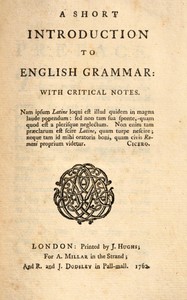
Before opening A short introduction to English grammar — Themes and Context, the edition data offers a quick orientation: 31,546 words, 2 hr 18 min estimated reading time, and 12 detected text sections.
The text analysis averages about 19.8 words per sentence, while the detected sections provide another way to judge how the source is divided.
Project Gutenberg metadata also associates the work with “English language -- Grammar -- Early works to 1800,” connecting these edition facts with the source record’s subject description.
Explore this collection
These alternatives are selected using recorded categories and estimated reading time.
About 156 minutes
Grammar
35,665 recorded words. 18 minutes difference from this book's estimate.
View Gutenberg source #69603About 101 minutes
Grammar
23,046 recorded words. 37 minutes difference from this book's estimate.
View Gutenberg source #76725About 97 minutes
Grammar
22,264 recorded words. 41 minutes difference from this book's estimate.
View Gutenberg source #69207Search stored excerpts and compare books → Choose by your preferences →
Choices use stored catalog measurements. Estimates vary with reading speed. A shared category is a catalog label, not a claim that two books have the same argument or literary quality.
Search reads excerpt text stored with this catalog and links to its associated Gutenberg record. The connection is stored in the site database; this tool does not recheck that every excerpt is word-for-word identical to that external record. Excerpt search does not cover every chapter and does not verify historical publication dates.
Catalog snapshot checked: 2026-09-26. Coverage: 93 public books, 93 available source excerpts.
Calculated from edition completeness, EPUB availability, text structure and catalogue metadata. Not a user rating.
Total of 100 points, scaled to a 2.5-5.0 range. Editions with an empty description or a missing EPUB file are not scored.
Public-domain source text
The source text is kept in the dedicated reader, separate from this catalogue record and its commentary.
Robert Lowth opens his 1762 grammar by citing Jonathan Swift's public remonstrance that English 'offended against every part of Grammar.' Lowth does not dispute the charge but redirects it: the fault lies not in the language's nature, which he calls 'perhaps of all the present European Languages by much the most simple in its form and construction,' but in the lack of systematic attention. His preface thus sets a dual agenda—to demonstrate that English is reducible to rules and to supply those rules with critical notes that often cite literary examples, especially from Milton and Addison.
Lowth treats Swift's 1712 letter to the Earl of Oxford as a touchstone, quoting Swift's claim that English 'in many instances ... offended against every part of Grammar.' He then asks what the charge means: does it describe the actual usage of 'the politest part of the nation' and 'our most approved authors'? If so, Lowth concedes, the charge is true. But if it implies that English is inherently irregular, he rejects that outright. The distinction is crucial: Lowth aims to correct usage, not to invent a system. He praises Swift as 'one of our most correct, and perhaps our very best prose writer,' using Swift's own authority to justify the project. This move frames the grammar as a response to a recognized problem, not a pedantic exercise.
Lowth asserts that English 'is perhaps of all the present European Languages by much the most simple in its form and construction,' and even claims it surpasses ancient languages in simplicity. He supports this by noting that substantives have only one case variation, adjectives admit no change except comparison, and words undergo few inflections. Yet the excerpts do not show him systematically proving this claim with data; instead, the claim appears in the preface as a premise. The grammar itself then proceeds to detail parts of speech, syntax, and punctuation, implying that simplicity does not mean absence of rules. Readers should note that Lowth's argument for simplicity is rhetorical, not empirical, and the critical notes often point out errors in respected authors, complicating the picture of a naturally simple language.
Lowth's treatment of punctuation reveals his method: he treats commas, semicolons, and periods as markers of syntactic structure, not mere pauses. For example, he explains that a compounded sentence—one with a relative clause inserted—'must therefore be distinguished into its component parts by a Point placed on each side of the additional Sentence.' He then dissects a passage from Addison, showing how 'chastity, fidelity, devotion' are adjuncts that each imply a separate sentence. This approach turns punctuation into a tool for parsing grammar. Lowth also distinguishes between simple and compounded members of sentences, and specifies when commas are needed (e.g., for nouns in apposition with many terms) and when they may be omitted (e.g., in short comparative sentences). His examples from Milton and Pope ground the rules in literary practice.
Lowth's grammar is best read as a period document that both reflects and shaped eighteenth-century ideas of correctness. The critical notes—often pointing out what 'offends against grammar' in canonical writers—show that the rules were contested, not settled. Readers interested in the history of English usage will find here a key text that treats grammar as a matter of national improvement, not mere description.
I keep returning to Robert Lowth’s 1762 grammar, its tidy confidence that English could be tamed into rules. It reminds me, strangely, of A Handbook of the English Language — Context and Discussion, which softened that same impulse into something almost tender—less about mastery, more about listening. Same urgency, different weather.
Build a private reading journal entry for this title.