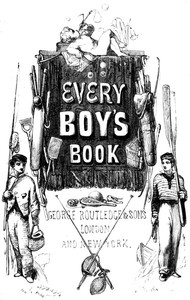
Every Boy's Book: A Complete Encyclopædia of Sports and Amusements — Context and Discussion

(0 User reviews)   26
In Category - Language Study
Routledge, Edmund, 1843-1899 [Editor] Project Gutenberg 2013 Not confirmed
Amusements; Handicraft for boys; Sports Readers of public-domain and historical texts
Project Gutenberg digital edition en

Edition facts

Words 318,442
Reading time 1385 min
Text sections 41

The catalog record for Every Boy's Book: A Complete Encyclopædia of Sports and Amusements — Context and Discussion provides practical reading context through 318,442 words, 23 hr 5 min estimated reading time, and 41 detected text sections.

The text analysis averages about 25.3 words per sentence, while the detected sections provide another way to judge how the source is divided.

Project Gutenberg metadata also associates the work with “Amusements,” connecting these edition facts with the source record’s subject description.

This editorial note examines the language, narrative voice, and shifts in pace within Edmund Routledge's 1869 encyclopaedia of sports and amusements, drawing on the preface and excerpts on mechanics and magnetism.
Share
Editorial Edition Score 4.9/5

Calculated from edition completeness, EPUB availability, text structure and catalogue metadata. Not a user rating.

How this score is calculated
  • Description quality20 pts
  • Title & short description10 pts
  • Source metadata20 pts
  • Text length15 pts
  • Chapters / structure15 pts
  • EPUB file integrity20 pts

Total of 100 points, scaled to a 2.5-5.0 range. Editions with an empty description or a missing EPUB file are not scored.

Edition quality

Read the Text

change places by running to the opposite ends, and Puss must endeavour to get into one of the vacant places before the opposite player is able to reach it; if he can do so, the player left out becomes Puss.

RED-CAP AND BLACK-CAP.

The players sit round in a circle, each taking a colour. Thus one is red-cap, another black-cap, and so on. One of them, who takes the place of master, and has no colour, taking up a cap says: “Hullo, here’s a false stitch. Who made it, blue-cap?” Blue-cap then answers, “Who, sir? I, sir?” “Yes, you, sir!” “Not I, sir.” “Who then, sir?” “Yellow-cap, sir.” Yellow-cap then starts up and says, “Who, sir? I, sir?” and goes through the dialogues, giving another colour. The player who neglects to start up when his colour is mentioned, or who does not repeat the question correctly, pays a forfeit.

Shadow Buff differs very materially from Blind Man’s Buff, but it is equally amusing. A large piece of white linen should be fastened neatly up at one end of room, so that it hangs quite smooth; Buff (not blinded) seats himself on a low stool with his face to the linen, and a table, on which is a lighted candle, should be placed about four or five feet behind him, and the rest of the lights in the room extinguished. Buffy’s playfellows next pass in succession, between the candle and him, distorting their features in as grotesque a manner as possible--hopping, limping, and performing various odd antics, so as to make their _shadows_ very unlike their usual looks. Buffy must then try to guess to whom the shadows belong, and if he guesses correctly, the player whose shadow he recognises takes his place. Buff is allowed only one guess for each person, and must not turn his head either to the right or left to see who passes.

_Birds, Beasts, and Fishes._--“Now, Tom,” said Harry, “get your slate and pencil, and I’ll show you such a jolly game. Well now, look here, I have put down h × × × a. Now that stands for a beast’s name, the first and last letters of which are _h_ and _a_, with three letters between, represented by the crosses.”

“Let’s see,” replied Tom, scratching his head, “I know--Hare.”

“You muff! There are only four letters in ‘hare,’ and five in my word. Try again--mind you have only three guesses; so look out.”

Tom wondered again for a minute, and then suddenly blurted out, “I know--Horse.”

“Wrong again,” replied Harry; “the last letter of Horse is _e_ and not _a_. Now be careful, Tom, for this is your last turn.”

Again Tom scratched his head, bit his fingers, and after meditating for at least two minutes and a half, shouted out in a moment of inspiration--“Hyena!”

As he was right, it now became his turn to put down a name. So he wrote on the slate s × × × × × w, at the same time telling Harry it was a bird; for according to the rules of this game you must say whether this name represents a beast, a fish, a bird, an insect, or a reptile.

Harry in a minute shouted “Sparrow!” and so the game went on; and such a capital game did Tom and Harry have, that they sent this account of it to us in the hope that we would make it known to the world in “Every Boy’s Book.”

_French and English._--On the slate should be drawn a plan somewhat like the following. The dots represent soldiers, one side being termed French and the other English. Each player is provided with a sharply pointed pencil, and the game is played as follows:--English, keeping the point of his pencil on a spot denoted by a cannon, draws it quickly across the slate in the direction of the other army. The pencil naturally leaves a line to mark his track, and if this mark passes through any of the men belonging to the other side, they are considered dead. The game is over as soon as all the men on one side are dead. Each player has a certain space on the slate allotted to him, and he may dispose his men in whatever part of it he pleases. The track of the pencil must be straight or curved; any shot in which there is an angle does not count. In p. 38 we give a battle-field where the strife is ended. In this the English side has killed all the opposite side in eight shots, while the French in eight have only been able to kill nine men.

The preface to the 1869 edition of Every Boy's Book announces a thorough remodelling: “scarcely anything now remains of the old work except the title.” This note examines how the editorial voice and pacing shift across the book’s diverse subjects, from the brisk, imperative tone of practical experiments to the more measured exposition of scientific principles. The excerpts reveal a work that oscillates between instructional manual and encyclopaedic reference, with noticeable changes in sentence length and direct address to the reader.

The Editorial Voice: From Collective Authority to Direct Instruction

The preface establishes a collaborative authorship: “the Publishers have endeavoured to obtain the aid of the most distinguished writers.” This collective voice lends authority but also creates a varied tone. In the mechanics section, the text shifts to direct commands: “Procure a coffee-canister,” “Cut out the figure of a horse.” The reader is addressed as a boy who will perform experiments. By contrast, the magnetism entry uses a more detached, explanatory style: “A sudden blow given to a magnet often destroys its magnetic power.” This alternation between imperative and declarative modes reflects the book’s dual purpose: to instruct through hands-on activity and to inform through systematic knowledge.

Pacing and Sentence Structure in Practical Demonstrations

The experiments are narrated in short, sequential steps. For example, the “Balanced Stick” instructions: “Procure a piece of wood… thrust into its upper end the blades of two penknives… Place the other end upon the tip of the fore-finger.” Each sentence advances the action, creating a brisk, procedural rhythm. In contrast, the opening of the mechanics section lists properties of matter in a single sentence: “Solidity (or Impenetrability), Divisibility, Mobility, Elasticity, Brittleness, Malleability, Ductility, and Tenacity.” This list slows the pace, demanding careful reading. The book thus modulates tempo: rapid for tasks, deliberate for concepts.

Recurring Motifs: Balance, Centre of Gravity, and the Tangible World

Several excerpts return to the concept of balance and centre of gravity. The “Prancing Horse,” the “Chinese Mandarin,” and the “Balanced Stick” all illustrate equilibrium through physical manipulation. The language is concrete: “the centre of gravity is that part about which all the other parts equally balance each other.” This repetition of a core principle across different activities—toys, figures, sticks—reinforces learning through varied examples. The book’s voice remains grounded in tangible objects: coffee-canisters, lead bullets, penknives. Even when discussing abstract laws, it anchors them in familiar items, maintaining a consistent material focus.

Readers approaching Every Boy's Book should attend to how its instructional voice shifts between brisk commands and measured explanations. The book rewards both browsing and sequential reading; the experiments invite active participation, while the encyclopaedic entries reward slower study. Noticing these changes in pace and address can deepen one’s appreciation of how the editors balanced entertainment with education.

That rainy afternoon, I kept returning to the 1869 encyclopaedia’s careful instructions on magnetism, its Victorian certainty oddly comforting. Wandering later, I found myself in a quieter corner, thinking how words could be as precise as levers, and picked up A Desk-Book of Errors in English Including Notes on Colloquialisms and Slang to be Avoided in Conversation — Themes and Context. The old needle simply swung that way.

There are no reviews for this eBook.

0
0 out of 5 (0 User reviews )

Add a Review

Your Rating *
There are no comments for this eBook.

Reader reflection

Record your reading impressions

A brief reflection can help important ideas stay with you longer.

Your progress 0 / 10
1

What is your current status with this title?

2

How much did you enjoy the reading experience?

3

Would you recommend this book to another reader?

4

How easy was the book to follow?

Related eBooks