About 101 minutes
Hungarian grammar — Edition Insights
Grammar
23,046 recorded words. 4 minutes difference from this book's estimate.
View Gutenberg source #76725
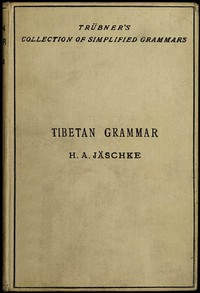
Before opening Tibetan Grammar — Inside the Classic, the edition data offers a quick orientation: 22,264 words, 1 hr 37 min estimated reading time, and 10 detected text sections.
The text analysis averages about 12.5 words per sentence, while the detected sections provide another way to judge how the source is divided.
Project Gutenberg metadata also associates the work with “Tibetan language -- Grammar,” connecting these edition facts with the source record’s subject description.
Explore this collection
These alternatives are selected using recorded categories and estimated reading time.
About 101 minutes
Grammar
23,046 recorded words. 4 minutes difference from this book's estimate.
View Gutenberg source #76725About 138 minutes
Grammar
31,546 recorded words. 41 minutes difference from this book's estimate.
View Gutenberg source #72554About 43 minutes
Grammar
9,870 recorded words. 54 minutes difference from this book's estimate.
View Gutenberg source #11130Search stored excerpts and compare books → Choose by your preferences →
Choices use stored catalog measurements. Estimates vary with reading speed. A shared category is a catalog label, not a claim that two books have the same argument or literary quality.
Search reads excerpt text stored with this catalog and links to its associated Gutenberg record. The connection is stored in the site database; this tool does not recheck that every excerpt is word-for-word identical to that external record. Excerpt search does not cover every chapter and does not verify historical publication dates.
Catalog snapshot checked: 2026-09-26. Coverage: 93 public books, 93 available source excerpts.
Calculated from edition completeness, EPUB availability, text structure and catalogue metadata. Not a user rating.
Total of 100 points, scaled to a 2.5-5.0 range. Editions with an empty description or a missing EPUB file are not scored.
Public-domain source text
The source text is kept in the dedicated reader, separate from this catalogue record and its commentary.
H. A. Jäschke's Tibetan Grammar, prepared for a second edition by Dr. H. Wenzel in 1883, is distinguished by its attention to the Western Tibetan (WT) dialect, a choice shaped by Jäschke's missionary work in Kyelaṅ. The preface notes that Jäschke, prevented by ill-health from revising his 1865 lithographed edition, provided manuscript notes that Wenzel used sparingly, adding remarks from texts like Milaraspa and further observations on Western Tibetan vernacular. This edition thus reflects a specific linguistic focus rather than a comprehensive survey of all Tibetan dialects.
The grammar consistently prioritizes Western Tibetan forms, often contrasting them with Central Tibetan (CT) usage. For instance, in the imperative formation, Jäschke notes that WT changes only the vowel of the perfect root, as in btong 'give!' from btang, while CT more frequently employs the particle cig and does not exclusively prefer the perfect root. This dialectal lens is also evident in the treatment of the verb 'to be': the respectful form lags-pa is explicitly marked as never used in WT, whereas yod and bzhugs are in general use. Such distinctions suggest that the grammar is not a neutral compendium but a document shaped by Jäschke's fieldwork in a specific region.
Jäschke devotes careful attention to the classification of verbs by number of roots—one-rooted, four-rooted, etc.—and to periphrastic constructions that compensate for root deficiencies. For example, the intensive verb formed by combining byed 'to do' with the terminative infinitive of another verb allows one-rooted verbs like mthong 'see' to acquire distinct forms for present, past, future, and imperative. The future tense of bya('o) is noted to express necessity or obligation, as in brjod 'must not be uttered'. Jäschke remarks that spoken WT lacks this convenience, possessing only the intensive imperative formed with btong. This analysis reveals a grammarian attentive to both literary and colloquial registers.
The grammar systematically records honorific or respectful forms, a feature essential for navigating Tibetan social hierarchies. For the verb 'to be', Jäschke lists multiple stems: yin (neutral), lags (elegant/respectful), yod (existential), mchis (elegant but seldom heard), and bzhugs (respectful). When expressing possession, the respectful term is not bzhugs but mnga', as in the question rgyal po la mnga' ma mchis sam 'has not the King an indisposition?'—a phrase Jäschke glosses as 'is Your Majesty ill?'. Such details indicate that the grammar was designed not only for linguistic analysis but also for practical communication in a society where speech register carries significant social weight.
The preface, written by editor H. Wenzel, provides crucial context for understanding the grammar's scope. Wenzel states that Jäschke's ill health prevented his direct involvement, and that only sparing use was made of his manuscript notes. The additions include remarks from Gyalrabs and Milaraspa, and further observations on Western Tibetan vernacular. This editorial process means that the published text is a composite: Jäschke's original framework supplemented by Wenzel's selections. Readers should be aware that the grammar's authority rests on Jäschke's fieldwork but is mediated through an editor who exercised discretion in incorporating new material. The result is a work that is both a product of its time and a reflection of specific scholarly choices.
Readers approaching Jäschke's Tibetan Grammar should keep in mind its dual character: it is both a systematic reference and a document of a particular linguistic encounter. The emphasis on Western Tibetan, the careful parsing of verb systems, and the attention to honorifics all stem from Jäschke's missionary context. The grammar rewards close reading not only for its rules but for the glimpses it offers into the spoken language of 19th-century Ladakh and the challenges of describing a language with multiple registers and dialectal variation.
There’s something deeply comforting in Jäschke’s careful grammar, the way he lingers over verb roots like old friends, catching respectful speech forms mid-flight. It reminds me of opening that other book, Bisayan grammar and notes on Bisayan rhetoric and poetics and Filipino dialectology — Story, Setting & Ideas, and feeling the same quiet ache for languages preserved in ink alone. We only ever catch echoes.
Save your reaction, strongest insight, and memorable passage.