About 97 minutes
Tibetan Grammar — Inside the Classic
Grammar
22,264 recorded words. 4 minutes difference from this book's estimate.
View Gutenberg source #69207
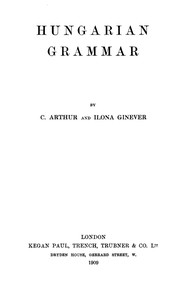
The source record for Hungarian grammar — Edition Insights measures this digital text at 23,046 words, 1 hr 41 min estimated reading time, and 25 detected text sections.
The text analysis averages about 13.1 words per sentence, while the detected sections provide another way to judge how the source is divided.
Project Gutenberg metadata also associates the work with “Hungarian language -- Grammar,” connecting these edition facts with the source record’s subject description.
Explore this collection
These alternatives are selected using recorded categories and estimated reading time.
About 97 minutes
Grammar
22,264 recorded words. 4 minutes difference from this book's estimate.
View Gutenberg source #69207About 138 minutes
Grammar
31,546 recorded words. 37 minutes difference from this book's estimate.
View Gutenberg source #72554About 156 minutes
Grammar
35,665 recorded words. 55 minutes difference from this book's estimate.
View Gutenberg source #69603Search stored excerpts and compare books → Choose by your preferences →
Choices use stored catalog measurements. Estimates vary with reading speed. A shared category is a catalog label, not a claim that two books have the same argument or literary quality.
Search reads excerpt text stored with this catalog and links to its associated Gutenberg record. The connection is stored in the site database; this tool does not recheck that every excerpt is word-for-word identical to that external record. Excerpt search does not cover every chapter and does not verify historical publication dates.
Catalog snapshot checked: 2026-09-26. Coverage: 93 public books, 93 available source excerpts.
Calculated from edition completeness, EPUB availability, text structure and catalogue metadata. Not a user rating.
Total of 100 points, scaled to a 2.5-5.0 range. Editions with an empty description or a missing EPUB file are not scored.
Public-domain source text
The source text is kept in the dedicated reader, separate from this catalogue record and its commentary.
The preface directly addresses a common misconception: Hungarian is not inherently difficult, but its reputation stems from poor exposition in other grammars. The authors assert that once vowel harmony and a few verb rules are grasped, the language presents no great difficulty—a claim that shapes the entire book's approach.
The table of contents reveals a methodical progression: alphabet, article, noun, personal suffixes, postpositions, adjective, pronoun, and verb. The verb section, with its extensive paradigms for lenni (to be), hinni (to believe), enni (to eat), and others, forms the core of the grammar. A first-time reader should use these tables as a reference while working through earlier chapters.
The preface is a compact manifesto. The Ginevers claim that Hungarian is easier for an English student than French or German, a bold statement that sets the tone. They attribute the language's difficulty to bad and complicated exposition in other textbooks, implying that their own method is superior. The key features they highlight are the use of suffixes instead of pronouns and prepositions, and the law of vowel harmony between a word and its suffixes. These two principles, they argue, unlock the language. The preface also mentions a vocabulary and common phrases for visitors to Hungary, suggesting a practical orientation. For a first reading, this preface is essential: it frames the grammar as a streamlined tool, not an exhaustive reference.
The verb paradigms occupy a substantial portion of the excerpts. The authors present full conjugations for indicative, imperative, subjunctive, conditional, infinitive, and participles. For example, lenni (to be) is given in all moods and tenses, including the subjunctive past voltam legyén and the conditional past voltam volna. The verb hinni (to believe) shows the indefinite and definite conjugations side by side, a critical distinction in Hungarian. The ik verbs (e.g., aludni, to sleep) are treated separately, with forms like alszom and aludtam. A first-time learner should study these tables carefully, noting patterns such as the future formed with fog plus infinitive. The inclusion of irregular verbs like jönni (to come) and menni (to go) shows the authors' thoroughness.
A short section on impersonal verbs lists weather expressions: esik (it rains), villámlik (it lightens), dörög (it thunders), havazik (it snows). The verb kelleni (to be necessary) is discussed in detail, with the note that it can be used personally (kellek, I am needed) but is more often impersonal. The authors also mention verbs requiring a dative or accusative, such as illik nekem (it is becoming for me) and engem illet (it concerns me). This section, though brief, illustrates the grammar's practical bent. The promised vocabulary and common phrases for travelers are not excerpted here, but their existence reinforces the book's aim to be serviceable for visitors. A first reader should note that these impersonal constructions are common in everyday Hungarian.
The table of contents shows 25 chapters, but only the first eight are listed in the excerpt: Alphabet, Article, Noun, Personal Suffixes, Suffixes for Place/Direction, Postpositions, Adjective, Pronoun. The verb chapters likely follow. The book is part of Trübner's Simplified Grammars series, which includes languages like Basque, Tibetan, and Albanian—indicating a consistent pedagogical approach across unrelated languages. The authors, C. Arthur Ginever and Ilona Ginever (née de Győry), bring both academic and native-speaker expertise; Ilona's Budapest origin is noted in the preface. A first-time reader should use the table of contents to locate specific topics, but the verb tables may be the most frequently consulted section. The grammar is concise (23,046 words), making it manageable for self-study.
This grammar is best used as a reference to be consulted alongside practice, not read cover to cover. Start with the preface to understand the authors' philosophy, then work through the alphabet and noun chapters before tackling the verb tables. The vocabulary and phrase list at the end will be useful for building practical sentences. The book's brevity and focus on core structures make it a solid starting point for an English speaker learning Hungarian.
There’s something tender about a century-old grammar book, the way it assumes Hungarian might be gentler than French. I find myself thinking of that quiet optimism when I set it down for another volume, the one about Tibetan, as if each language carries its own small promise of discovery. Tibetan Grammar — Inside the Classic feels like a familiar, unhurried companion.
Answer a few questions and save a private reflection on this device.